Girl Talk #1: Welcome to Junior High

When I was in middle school, I read several popular book series catered to young girls: Sweet Valley High (and Twins and University, too), Baby-Sitter’s Club, and even one or two Canby Hall books. Though I read more Sweet Valley than anything else, looking back I see that series was the worst of the lot. The selfish, shallow characters promoted unhealthy and amoral ideals for young girls. Despite having read hundreds of those books, I remember the plots of only a dozen or so, which fails the book test. For me, the one question book test is this: Do you remember the plot of ______ years after having read it? If you don’t, perhaps the book didn’t have a profound impact on you.

The Sweet Valley books were re-capped on a website called The Dairi Burger, which I followed a decade ago. Robin Hardwick does an amazing job recapping those books, and she does it with side-splitting humor, too. She even calls the books out on their crap. The authors had a habit of fat-shaming and the characters bullied people who were different. Even the practical, “smart” and “kind” twin often cheated on her boyfriend. Every book dedicated space to fawning over how good-looking the twins were. The twins’ mother was often mistaken for their older sister, and other women were so jealous of her looks that someone once tried to kidnap her and steal her face for a face transplant. No joke. Those books were beyond ridiculous.

The Girl Talk books had a profound impact on me. I remember the four best friends on which the books focused: Katie Campbell, Allison Cloud, Sabrina Wells, and Randy Zak. Just browsing over the books’ covers online, I remember the plots of most of the ones I read. These books weren’t as readily available as the Sweet Valley series or the Babysitter’s Club. I believe I bought my Girl Talk books via a school book fair’s catalogue. I never saw them for sale at the Barnes and Noble or at Books a Million like the other popular girls series. I was heartbroken when the books stopped after #45. And I couldn’t find them in local bookstores. Now, with the use of Amazon and Abebooks, I can go back and read them again. I still have a few that I bought when I was a kid, and I can order the others.
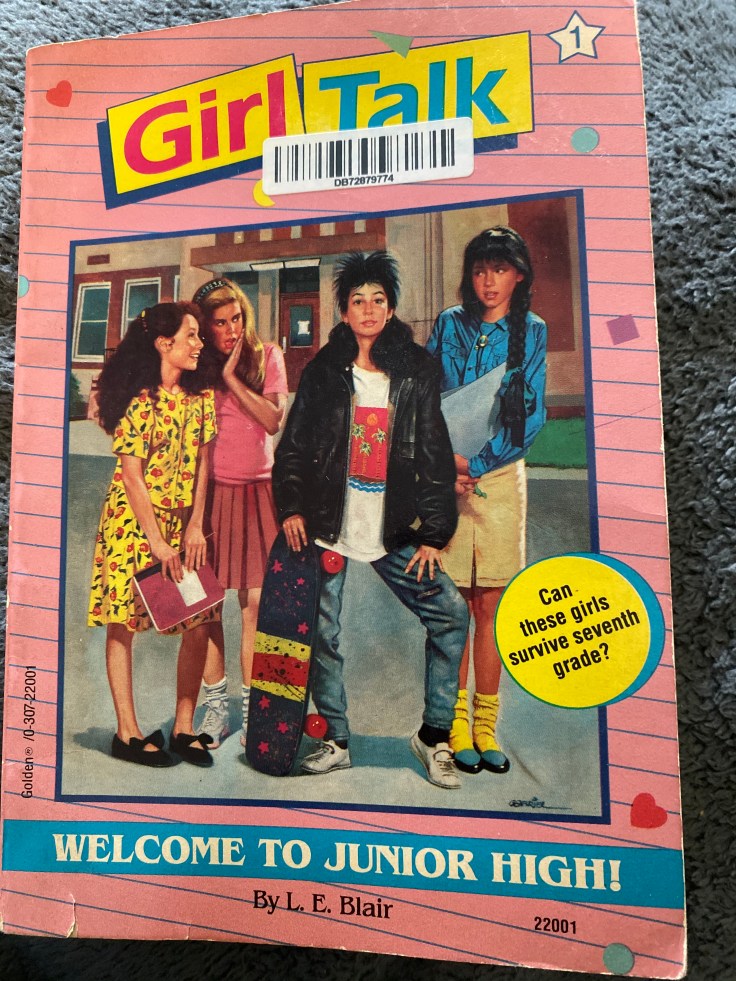
Girl Talk #1

Here goes. Katie, Allison, Sabrina, and Randy live in the small town of Acorn Falls, Minnesota. They’re 12-13 years old, and in the first book, which I’m re-capping here, they have just begun 7th grade. Each book is narrated by one of the four main characters. Sabrina Wells narrates this first book called Welcome to Junior High. We find out that Sabrina has four older brothers, including a twin brother named Sam. She’s bubbly and loves fashion magazines and horoscopes. She’s also boy-crazy. In the span of this first book (all of the books are around 120 pages and printed in big script, so that you could read one in about two hours), Sabrina has crushes on three different boys: her brother’s friend Nick, a ninth grade boy named Spike who plays in a local band, and an 8th grade boy named Alec whose lap she lands on while trying to slip out of the 8th grade math class she accidentally walked into while running late on the first day of school. Alec is the one she crushes on first, and she loves that he’s an “older man.” He looks just like Tom Cruise, her favorite actor. Later, when she meets Spike, she thinks he reminds her of Johnny Depp, her other favorite actor. It’s amazing how these books are so dated (this first one came out in 1990), yet some of the cultural references remain the same. I guess some girls still like Cruise and Depp, though they’re kinda aged heartthrobs now. I guess if these books were updated, the young girls would like…yikes, you can tell I’m almost 40. No idea who the girls would swoon over. Lol. Until I re-read this one, I didn’t realize Johnny Depp was so famous already in 1990. But I guess Nightmare on Elm Street and Platoon had already been released, and Scissorhands came out that same year.

Anyway, here’s the plot. The homecoming dance is coming up, and the whole story leads up to that big event. Sabrina wants to go with Alec the 8th grader, but he’s already been spotted hanging around with the principal’s daughter, Stacy Hansen, a snooty 7th grade girl who wears heels already and always dresses nice. Sabrina also thinks Nick Robbins, her brother’s friend, is cute, but he’s in the 7th grade with her, and she’s decided she only likes “older” men. Nick asks Sabrina to the dance while they are lining up to march in the town parade. Nick accidentally knocks her over with his drum, and she tries to talk to him but clumsily spits out her clarinet reed. Cute scene. Anyway, Sabrina agrees to go to the dance with Nick, but later when she is decorating the gym with Randy, Katie, and Allison, this 9th grader named Spike (who has black eyes like Johnny Depp) comes in and asks her to dance. Nick walks in and sees her with Spike and is obviously jealous, only Sabrina is too dense to realize it. Later, Nick calls and says he won’t go to the dance with her because he has already asked someone else. Sabrina is crushed, but her friends talk her into going to the dance anyway. At first she pouts because she sees Nick talking to some other girl she doesn’t like and because Alec is dancing with Stacy. Then, Spike, whose band is playing at the dance, literally puts a spotlight on her and dedicates a song to her. Nick comes forward and asks her to dance. Though she shouldn’t even be talking to him since he dumped her, they talk as they dance. He explains that he was angry when he saw her with Spike, and he admits he never asked anyone else to the dance. They agree to be friends. The book and the night end with Sabrina hanging out with Randy, Katie, and Allison.

There are some side plots. One is that Katie goes to the dance with Sabrina’s twin brother, Sam, and for reasons unknown this bothers Sabrina. Randy is new to town from New York City. Her haircut is spiked on top, and when Sabrina first meets her Randy wears a leather bomber jacket, ripped jeans, and a T-shirt with palm trees on it. (Sooo cool, according to Sabrina.) Allison is the quiet one who is Native American. I remember being enthralled by her when I was a child. Most of the books I read had majority white characters. I’d never read a story with Native Americans until I read Allison’s character. Her personality is bookish and quiet, very similar to mine. I used to share these books with my girl cousin when I was in middle school, and Allison was her favorite character. I liked Allison and Katie the best when I was a kid. I wonder if my opinion will change as I go through them again.

Grade: B. Sabrina is a little too boy crazy for my taste. She’s still quite nice, though. I also like that Randy kept standing up for Sabrina whenever Stacy tried to bully and belittle her. In one scene, Stacy and her friends steal Sabrina’s self-improvement notebook, which is basically a diary in which Sabrina writes about her goals to better herself, and Stacy and her friends read the thing aloud in front of a group of kids in the hallway. Sabrina is embarrassed, because anything embarrasses a tween-age girl. Randy steps in, snatches the book away and gives it back to Sabrina. She also steps in during another scene, knocks into Stacy and spills Stacy’s entire lunch all over her. Ah. Seventh grade scandals.

Next time, I’ll recap #2, and we’ll learn more about Katie Campbell, who narrates that one.
The Long-Awaited Conclusion to the Logan Family Series

I’ve loved Mildred D. Taylor’s books since I was a child. In eighth grade, I listened as my Georgia history teacher, Mr. Benton, read aloud from Roll of Thunder, Hear My Cry each week. I fell in love with Cassie Logan, the book’s intuitive, beautiful protagonist. The other books I read as a child featured mostly white female protagonists. Sure, there was Allison Cloud, the bookish Native American girl from Girl Talk, and there were Claudia Kishi and Jessi Ramsey from The Babysitter’s Club, but other than those few the characters in the books I read were mostly white.

The white authors I read frequently reflected on how blue a character’s eyes were, and I could always tell what the authors’ beauty standards were. The authors of the Sweet Valley series loved long blonde hair and tan skin (but not black skin) and a size six body. In the stories I write, the characters don’t have blue eyes, and I don’t favor the ultra-thin beauty standard either. I often struggle to describe my beautiful black female characters without using food comparisons. Yes, that’s a thing. I’ve read books by writers, both black and white, who say a black woman is peanut butter brown, has skin that shines like pudding, or is the color of a pecan. Food. Food. Food.

Reading a book series in which the black female telling the story doesn’t suffer low self-esteem is something that gave me hope as a child. Stop for a moment and consider the most popular dark-skinned black women in literature. There’s Celie in The Color Purple, the narrator of Salvage the Bones, and of course Pecola Breedlove in The Bluest Eye. Though there’s hope at the end of The Color Purple, overall Celie and the other protagonists from the aforementioned books are stepped on, shat on, and all but tarred and feathered by their tormentors.

Then we have Cassie Logan, a young woman who is smart and hard-working and has a life that, even in Mississippi in the 1930s-1940s, isn’t completely hopeless. I’m proud of Cassie Logan, proud as if she were my own daughter. I love how her family sticks up for one another and stays together. I can write beautiful black females because another author came before me and wrote Cassie Logan and did it like a boss. Mildred Taylor didn’t write black women with white readers in mind. She didn’t say that Cassie was pretty “for a colored girl” or that she had white features, like thin lips or a thin nose to make her somehow more palatable or attractive to white people.

Today, I went to Barnes & Noble and bought the last book in the Logan family series: All the Days Past, All the Days to Come. (This says a lot because I never buy those expensive ass brand-new hardcovers–the last one I bought was Harper Lee’s second novel–and I prefer to buy used books cheaply.) For the next week, I will catch up with Cassie Logan, who last narrated the series in a book released in 1990. Yes, it’s been thirty years since The Road to Memphis was first published, and the other books Taylor has written since then were both prequels and not narrated by Cassie. This new book was not only a long time coming, but one I did not expect until last summer when I saw it available for a pre-release purchase on Audible. For years, I’d thought Taylor had passed away. I kept wondering if she’d died before finishing the series. For years, I’ve wanted to know what became of Cassie’s family after WWII. Did her brothers serve in the armed forces? Did Cassie pursue her dream of becoming a lawyer? I wanted to know if Cassie would marry the lawyer she met in 1941 or if she’d marry Moe, the sweet man from her community. Now, sitting here typing this, with the newest and last installment of the beloved series, I wonder, will this book, like all my favorite books, break my heart?


The Thing that Bothered Me This Week: No One in This Town Can Do a Black Woman’s Hair

I’ve been trying to find a good hairdresser in middle Tennessee since last year. I went to one lady who did just an okay job, but the bigger problem is I have to book her two weeks in advance. For the past few months I’ve driven past a certain salon here in town, and my mother has urged me to go in and ask if they do black hair. I kept looking for signs that they did my type of hair. I never see people going in or out of the salon as I’m driving by, but granted, I don’t often pay attention every time I drive by. I have noticecd that the boy in the sign out in front of the salon looks Hispanic or possibly mixed race, and the other poster is of a white woman.

I finally called yesterday and asked if they did black hair. The woman on the phone said she didn’t but that one of her co-workers, who was absent that day, does black hair. I gave her my number and she said she’d call right back. After she didn’t call me back yesterday, I drove to the salon to make an appointment. The lady who does black hair wasn’t working today either. So they called and got her phone number from someone else. I tried calling her, but her phone goes straight to voicemail. I left her a message, but for some reason I doubt she’ll get back to me.

I called the JC Penney hair salon today, even though I’ve never seen any negroes in their salon at any time ever. The lady on the phone said she’s the one at the JC Penney salon who can do black hair. I felt relieved. Two seconds later she asked, “What kind of hair do you have?”

“Just regular black people hair,” I said, and then burst into 1/3 amused, 1/3 annoyed, and 1/3 baffled laughter.

She did not laugh.

“I mean, is it very coarse?” she asked.

“Yeah,” I said, hesitating a little. I’d heard black women hairdressers in the past refer to it as soft, and I’m not sure if it would be coarse compared to other black people’s hair or if it would only be coarse to white people. “Yes,” I said, sounding a bit more confident. “It’s coarse and curly. Kinky too.”

She made the appointment for me, and after we hung up the phone she called back five minutes later as I was driving to work. She left me a voicemail saying she doesn’t have “the right products” to “stretch out” my hair.

WTF? I never asked for a relaxer. I only want someone to wash my hair and set it in thin rollers and put me under a hair dryer. I’d do it myself, but I’m not good with rolling my hair to make it lay the way the professionals do it. The JC Penney lady gave me the number to another white lady who supposedly does black hair. I called this lady and she told me her hair dryer is broken and thus she cannot do my hair either. Am I going to have to drive all the way to Nashville to get my hair done? Looks like.

The Person Who Bothered Me This Week: Dennis Rodman

Dennis Rodman has been on my mind lately. I remember when I was in high school a black man was killed by some white supremacists in Texas. One of my cousins claimed Rodman sent money and condolences to the victim’s family. I don’t know if this kind act can truly be attributed to Rodman, but just hearing a rumor that he did that gave me some respect for Rodman.

Last week, I watched ESPN’s documentary Rodman: for Better or Worse. It’s part of their 30 for 30 series in which they profile various athletes and teams. Anyway, I DVR’d the program and was half-watching it while lying on the couch dozing off when I heard a white woman being interviewed. This woman is someone close to Rodman, the matriarch of a family Rodman lived with when he was an adolescent after his own mother kicked him out of her house. Anyway, the white woman being interviewed said Rodman didn’t like black women, which disappoints me. What have black women ever done to Dennis Rodman?

I did a half-assed search on the web a few days ago to see if Rodman had publicly slurred or dissed black women. I found an article online from years ago in which he told a magazine that black women wouldn’t date him when he was poor. But is that a good enough reason to dislike all of us, especially considering that many white women probably wouldn’t have dated a poor version of Rodman either. The white woman in the 30 for 30 documentary openly admitted to calling Rodman the n-word when she grew angry at him, and Rodman said himself that growing up in Oklahoma in a white community he was often slurred and mistreated by whites. So why would he turn around and say that it’s black women he doesn’t like?  In the other part of his magazine interview, he claimed dating white women as an NBA player is popular, which we know already, but why turn against black women? The other thing he said is that dating white women brings something different, which makes it sound like he is aroused by taboo or fetishism, which is well within his rights, but it still doesn’t explain why no love for black women is given.

Anyway, I don’t like him anymore.

Orchard Keeper Writer’s Residency

I had the pleasure of staying for one week at the Orchard Keeper farm this summer. My time at the orchard was my first residency, and I spent it in the hills and mountains of northeast Tennessee near the Cumberland Gap. Though I wasn’t as disciplined as I would have liked to have been, I did get quite a bit of work done. The orchard is the perfect place for solitary writing time. No wifi. No tv. Just me and my computer’s word processing program. Needless to say, I felt a little lonely at times, but the solitude was perfect for my writing. Denton Loving, the man who owns the farm, was welcoming and super helpful. If you’re looking for a residency or a retreat, consider applying to this one.

orchard trailer
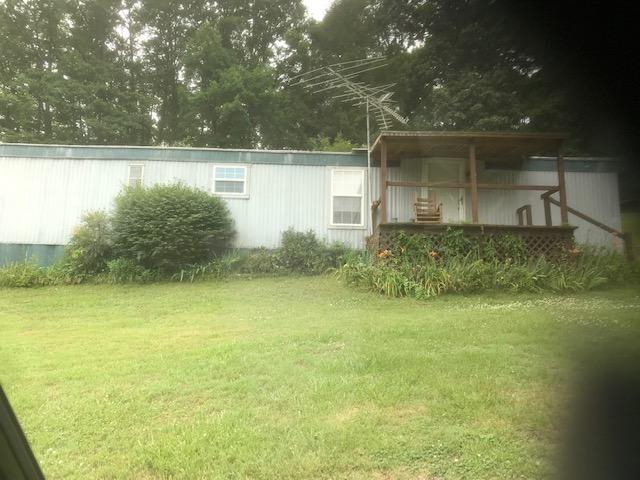
This is the trailer where I stayed.


My Favorites

I’m an English teacher and have also worked at a public library, which means people often ask which authors and books I enjoy. I have a penchant for Southern fiction, working-class literature,  and African-American literature. Here’s a short list of some of my favorite works:

Coming of Age in Mississippi by Anne Moody

Outer Banks by Anne Rivers Siddons

A Raisin in the Sun by Lorraine Hansberry

Upstate by Kalisha Buckhanon

Gap Creek by Robert Morgan

Big Stone Gap by Adriani Trigiani

“The Shipfitter’s Wife” by Dorianne Laux”

“What Do Women Want” by Kim Addonizio

“Scheherazade” by Richard Siken

Bastard Out of Carolina by Dorothy Allison

The Color of Water by James McBride

“Going to Meet the Man” by James Baldwin

“Ruby Tells All” by Miller Williams

“The Lesson” by Toni Cade Bambara

The Road to Memphis by Mildred D. Taylor

“When We Were Young and Confederate” by Jeremy Collins

“Superman and Me” by Sherman Alexie

“Barn Burning” by William Faulkner

Saving Grace by Lee Smith

Heavy by Kiese Laymon

Streetcar Named Desire by Tennessee Williams

Dolores Claiborne by Stephen King

”The Third and Final Continent” by Jhumpa Lahiri

“Nilda” by Junot Diaz

”Letter from Birmingham Jail” by Martin Luther King, Jr.

“Bullet in the Brain” by Tobias Wolff

“Time and Distance Overcome” by Eula Biss

Narrative of the Life of Frederick Douglass by Frederick Douglass

Maude by Donna Mabry


Welcome!

I’m a writer and teacher living in Tennessee, where I work as an assistant professor in the English department at Tennessee Tech University. I’ve designed this site to showcase my publications. I write fiction, poetry, and essays. Some of my favorite authors are Adriana Trigiani, Lorraine Hansberry, Anne Moody, Dorothy Allison, Rick Bragg, Lee Smith, Mildred D. Taylor, Robert Morgan, and Anne Rivers Siddons.

Blog at WordPress.com.

Up ↑