Big Sky, Episode 6: The Wolves Are Always out for Blood

This was the first episode back after the winter hiatus. If you remember correctly from back in December, Cassie returned to the bar and found Legarski there with the kidnapped trio. She puts a bullet in Legarski’s head. He falls down, presumably dead, after muttering his catch phrase: “My, my, my.”

In this new episode, Legarski is somehow not dead. He’s hospitalized with a brain injury and unconscious, but clinging to life. His wife, Merilee, played by the wonderful Brooke Smith, is clueless about her husband’s criminal activities. Cops literally rip up the boards in her house looking for evidence of her husband’s crimes. Merilee’s also clueless as as to who her husband’s partner could be, and even though she’s danced with Ronald, she knows him by a different name.

Ronald speaks openly with his mother about his involvement in the kidnappings. He tells her that Legarski’s wife doesn’t know his identity. Still, Mama has her doubts. She’s afraid her son will go down. I think she should turn him in. I would. He deserves a looong prison sentence. Ronald, rather than fleeing the scene, paints the exterior of his long-haul truck cab blue and still hangs around his mother’s house. Not sure what he thinks he could accomplish by hanging around. One of his kidnap victims lives locally and could easily identify him, and if Legarski remembers anything he could–and probably would–implicate Ronald. Plus, Ronald’s mother keeps reminding him that the cops know Legarski’s accomplice is a trucker. Ronald responds by telling her he has to get into Legarski’s house and find whatever evidence would incriminate Ronald. Not sure why he thinks he could find evidence after the police have already searched the place, but I guess the writers wanted a reason to keep Ronald hanging around Helena, Montana.

The cops uncover Cody’s vehicle with his body inside. Jenny falls to the ground, grief-stricken. Cassie is upset, too, of course; however, she at first appears more upset about shooting Legarski than about Cody’s death.

Pic Courtesy of USA Today

Cody’s memorial service includes a sad speech from Jenny and lots of tears. Later, Jenny and Cassie vow to team up “just for this case.” I like their partnership, and if the show is extended past this first season, I’d like to see them together going after more bad guys associated with this trafficking ring. They don’t seem to have distinct personalities, though. Both women are tomboys who wear jeans and big belt buckles, and if we were to go through each woman’s closet, we’d find leather jackets and more than one cowboy hat.

Pic from IMBD

Jerri returns home to find that someone has left a note outside her trailer that says, “You don’t learn,” which was something Ronald had said to her after tasering her during the hostage horror. Earlier in the episode he sat in his pickup outside a restaurant and took pictures of her. Creepy.

Legarski’s eye pops open at the end of the episode. Stay tuned…

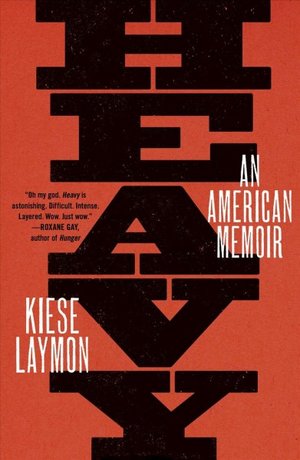
Memoirs by Kiese Laymon, Bakari Sellers, and Sally Field

I’m reading a lot of memoir lately. There’s something wonderful and exciting about hearing a person’s story in their own voice. Last year, I taught Heavy by Kiese Laymon in my nonfiction workshop. It’s one of the best books I read last year. Perhaps the thing I like best about it is that Kiese Laymon reads the audiobook himself. You get to hear his country, black Southern accent and how he pronounces words like “nan” and “scrimps” in his own dialect. Not everyone is a good reader for their own work, (or any work for that matter), but he’s a spectacular reader. He has great inflection and puts just the right amount of emotion in his voice. The story is mostly about his growing up years in Mississippi. Laymon has a mother who instilled in him the importance of education, and yet I hesitate to call her wonderful because she’s also angry and abusive toward him. Laymon’s title is a double entendre. He writes about heavy subjects, such as racism and poverty, but the memoir also focuses on how physically heavy he becomes as a result of his eating disorder. This book forced me to think about the ways in which people abuse and neglect their own bodies as a result of life problems or low self-esteem.

Bakari Sellers’s book, My Vanishing Country is another story about a country boy who achieves a lot through hard work and education. I think it’d be interesting to teach Laymon and Sellers alongside each other. Sellers became a lawyer and a politician at a young age, and his story is definitely inspiring. However, what I liked best about it was that he educated me on the Orangeburg Massacre, a Civil Rights era killing of protestors by police officers. This massacre is one I’d never heard of before. Three people died, and many more were injured when police opened fire on a large group of unarmed protestors.

Sally Field’s memoir, In Pieces, is a bit longer than it needs to be. I feel she spends too much time on her childhood. I haven’t heard quite all of the book yet, but I’ve heard enough to recommend it. She reads it herself and has a controlled voice that handles even sensitive subject matter with a quiet confidence. Field details her childhood and how she comes from a family of actors. She is sexually abused by her stepfather, which I think makes her vulnerable and lacking in self-confidence. It was surprising to learn that she often feared being an out-of-work actress. She’s made so many films and television series that I always thought of her as someone who has had constant work. Field basically says that in her early career she was typecast as an actress who was not to be taken seriously due to her role in The Flying Nun. I’m not old enough to remember that television series and it wasn’t in syndication when I was growing up. I’ve only seen her in serious roles, so it’s hard to imagine she was cast differently in her early career. One thing that didn’t surprise me was when she tells of a sleazy director who makes her take off her top and kiss him as part of her audition for a role. Later, he comes to her for sex while working with her on the film. Such a slimy story, but it’s not a surprising one, given what we’ve all heard and read about the Me, Too movement and how it’s exposed so many powerful men in Hollywood. Overall, in her book Sally Field comes across as more lonely than anything else. She also constantly desires approval from others. Like Kiese Laymon, Sally Field also suffers from an eating disorder. I bought this audiobook of hers because she’s one of my all-time favorite actresses. I loved her in Norma Rae, which is a favorite movie of mine.

Big Sky, Episode 5: “A Good Day to Die”

Crazy Legarski starts off this episode creeping up the staircase with a hammer in his hand. He pauses in the bedroom over his sleeping wife, looking ominously down at her. We see his disturbing fantasy of bashing her head in, but then she awakens perfectly fine to ask, “What are you doing?”Legarski responds by commenting on how she has danced with another man and how it drives him crazy to think about. Then, he blames himself for the fact that she went out dancing.

I think the writers are trying to make Legarski a complex character. He’s not just some monster killing for sport. He actually seems contrite and upset about his wrongdoings, and yet he never turns himself in to the police.

We’re given a flashback to a time when trucker guy was getting blown by a woman, Sage, in his truck. Legarski pulls him over and lectures him on “falling victim to the evil” that Sage offers him. The lecture is sooo bad. It’s like a Fox News show rhetoric. Legarski tells trucker guy that they can set Sage off on a better path. I guess the scene is supposed to show us Legarski rationalizes human trafficking by telling himself he’s doing these women a favor by selling them.

Cassie and Jenny convince local police to ambush Legarski at the compound. But joke’s on them. Trucker guy has already removed the kidnapped girls before Cassie and Jenny arrive with the police. Legarski gets the last laugh for the time being.

Photo Credit: TV.AV Club

Trucker guy takes the girls to the abandoned bar and holds them there. He cleans them up, and it’s implied that they’re about to be sold elsewhere. Legarski shows up and reveals that after this job he’ll officially quit the kidnapping/trafficking business. Legarski also tells trucker guy that his wife went dancing the previous night. This again makes me wonder what trucker guy is up to. What’s he gain from dancing with Legarski’s wife? Maybe he feels some satisfaction by knowing he could possibly seduce her if he wanted. Both men are despicable, but at least Legarski knows his actions are despicable and wants to stop. Trucker guy comes across as a true misogynist, and this show kinda explains his behavior by writing a dysfunctional relationship with his mother. In this episode, he even grabs Mama Dearest around the throat after she mentions that kidnapping those girls somehow fits in line with his “prurient urges,” and then accuses him of being a sexual predator. What prurient urges? Also, how does his mother know about said urges? Has she witnessed something? Later, trucker guy tells his mama that his “business partner” kidnapped the girls. This makes me wonder just how long Mama will wait before contacting the police.

Psycho trucker guy goes to see Legarski’s wife at her craft business again. She tells him she’s married, which he knows already, of course. He kisses her, and she responds as if she likes it. Not sure where that storyline is going. Will he use her to take revenge on her husband somehow?

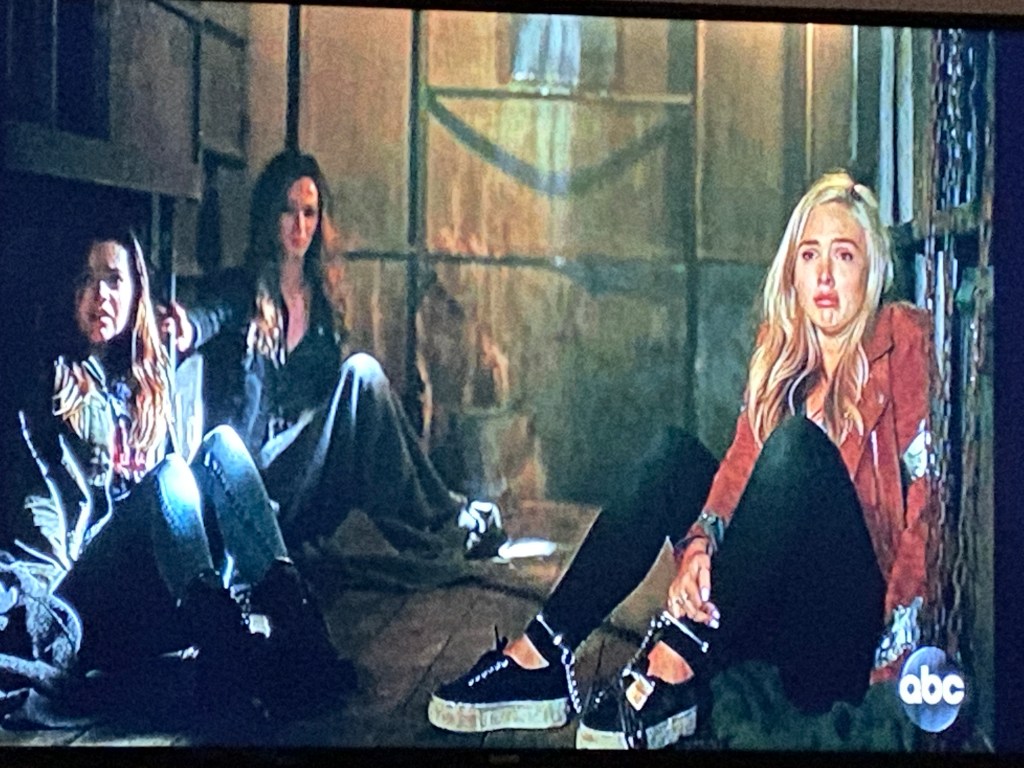
Cassie goes to the abandoned bar after being told by Legarski’s wife that Legarski is a creature of habit. In the bar, she finds him with the girls, who are gagged and tied up. Cassie, standing atop the staircase, has a standoff with Legarski as he calls up to her from the bottom of the stairs. She puts a bullet in his head and he falls over right after uttering his catch phrase: “My, my, my.”

Photo Credit: Entertainment Tonight

This was the winter finale episode of the series, which means we’ll have to wait a while to see what happens next. I wonder if the writers intended this to be a miniseries or a full show with multiple seasons. Killing off Legarski and finding the missing girls so soon makes me wonder where the show could possibly go from here. Maybe it’ll take Cassie a while to track down trucker Ronald and bring him to justice.

Big Sky returns on January 26, 2021.

Big Sky, Episode 4: “Unfinished Business”

This episode was a dud compared to episode three. I think it’s the weakest episode of the series thus far. Here’s the important stuff:

–Ronald has a weird moment in which he dumps his cereal on his mother’s head, just like a spoiled toddler. Rather than smack his face, Mama asks him if he has anything to do with the missing girls.

Pic courtesy of Cinemablend.com

–Rick Legarski hears about the missing girls on the radio as he’s driving. This isn’t the first time he’s heard about them in the media. And. He. Is. Livid. He calls Ronald in a teeth-gritting furor and commands him to meet at the abandoned bar where they do their illegal business. Legarski looks more than a little triggered when Ronald says his mother is suspicious. Legarski goes so far as to reach down for his service weapon, as though he’s considering killing his idiot crime partner. He doesn’t, of course.

–Back in the bunker, the girls are worried about Grace, whose leg looks infected. She’s in pain and has a fever. Ronald stops by and douses the leg with peroxide. Later, Legarski stops by to inject her with some medicine. We’re led to believe that her injury improves and that she’s no longer in danger of dying from infection.

–Cassie goes to the sheriff to ask for help keeping an eye on Legarski. The sheriff calls Legarski in for a private chat. As they talk, Legarski at first tries to sweet talk the sheriff and change the topic to take the focus off himself, and when that doesn’t work he plays the race card. This is something people don’t talk much about. People of color are often accused of playing the card, but white people do it sometimes too. During his race card rant, Legarski says the sheriff is doing a back flip in his rush to investigate him just because Cassie is black and made the complaint. Legarski claims it’s “open season on the badge.” He says anyone who claims blue lives matter is painted as a bigot (which is kinda true in many cases), but rather than gain him any leeway or sympathy from the sheriff, Legarski’s speech just makes him look angry and belligerent.

Pic taken from Bustle.com

–Cassie and Jenny go to the truck stop after viewing the parking lot footage from the night Jerrie was kidnapped. Cassie plays lookout while Jenny, dressed as a hooker in over-the-knee boots, goes up to a random trucker and tries to get a DNA sample from some items in his truck. The trucker, who’s already made her scrub herself down with sanitizer and even squirt her mouth with some liquid because he wants him a clean hooker, gets suspicious of Jenny. They end up brawling in the parking lot. She punches him down, and he reaches for his gun just as Cassie jumps out with her gun and shouts him down. It was like a scene from Charlie’s Angels or something.

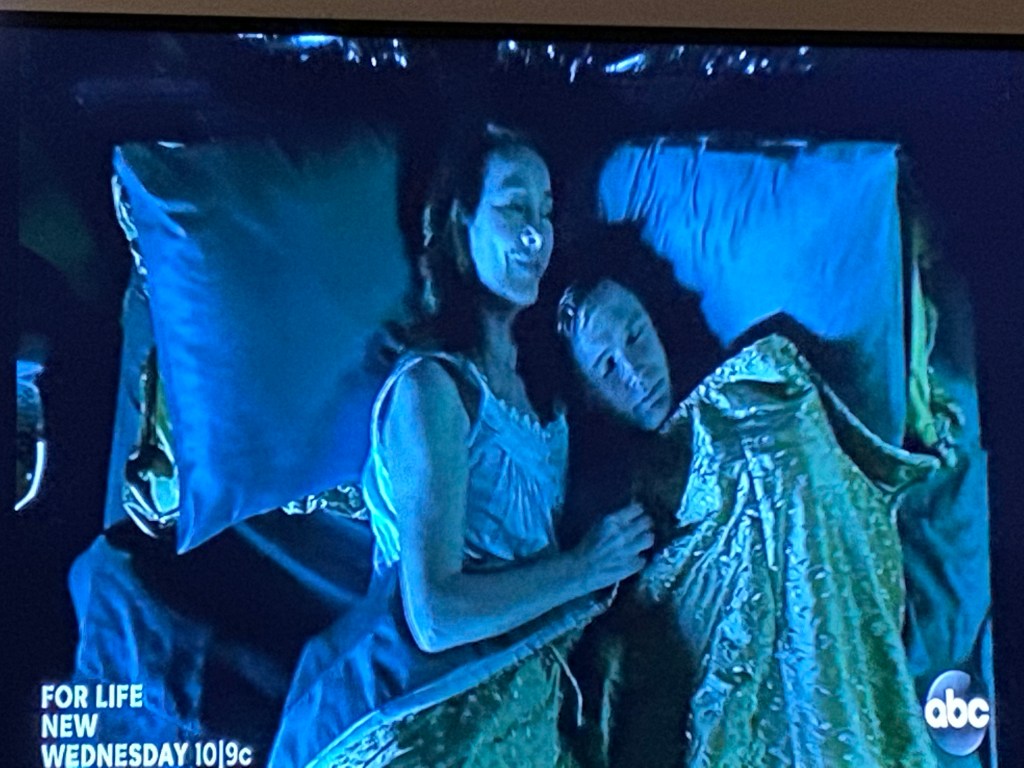
–Ronald goes to see Merilee, Legarski’s wife, at the quilt shop she runs. He buys a quilt and convinces her to go to an old-fashioned dance hall to meet him. That night, we see Merilee step into the dance hall–which is full of old folks, one of whom is spiking the punch bowl–and lose her courage and bail on him. Ronald chases Merilee out to the parking lot and convinces her to dance. They have a good time, though why they do is still uncertain. He’s pretty boring. Perhaps Merilee is just lonely. She is, after all, married to a psychopath, but then again Ronald is also a psychopath. Does she just happen to attract psychos, or is Ronald deliberately targeting Legarski’s wife for some reason? Not sure where the writers are going with this storyline. I mean, Ronald has to know Merilee is Rick’s wife. How many women named Merilee could possibly live in this small rural town?

–Cassie and Jenny tail Legarski to the place in the woods where the girls are being kept. At one point, they’re standing super close to the bunker and the girls are shouting for help from underground, but Cassie and Jenny can’t hear them.

My fave quote from this episode comes from Merrilee to Ronald after he calls her beautiful while buying a quilt from her:

“Ah, it’s still the same price. We’ve discontinued the flattery discount.”

I’m hoping next week’s episode will be more thrilling.

Gymnastics Reads

The books I’ve been listening to lately all involve gymnastics and abuse. I didn’t plan it that way. I listened to one, which made me aware that another existed, which reminded me I needed to listen to Dominique Moceanu’s memoir.

Twisted is a nonfiction book that focuses on multiple women who were interviewed to tell their story of being abused at the hands of Larry Nassar, the Michigan doctor who was convicted of sexual abuse and sentenced to up to 175 years in prison. I’d vaguely heard of the doctor before listening to the book, but this audiobook was the first time I learned the details of what Nassar did. I don’t recommend the book to anyone who is easily triggered by abuse stories. The women’s stories will anger and sadden you.

Another book I listened to recently is What Is a Girl Worth? Rachael Denhollander’s memoir of surviving sexual abuse. A teen victim of Nassar who came forward and helped to ignite the furor that got Nassar indicted, Denhollander’s account will enrage you. Why were her complaints not taken more seriously? Why did Michigan State University and USA Gymnastics not have a better system in play to handle abuse allegations? Here are answers to two popular questions that so many of these victims are asked:

Why didn’t you tell someone?

They did tell someone. They told their parents. They told their coaches. They told police. In many cases, the girls and women were gaslighted or simply not believed. Some of the people in charge were blinded by Larry Nassar’s sweet demeanor and professional occupation. He lied and said he was doing pelvic floor manipulation on many of his victims. Pelvic floor manipulation is a real technique, but Nassar wasn’t doing it the right way. Instead, he touched the victims inappropriately. In many cases it was just the victim’s word against Nassar’s.

Why didn’t you come forward sooner?

Many of them did come forward sooner. There are reports from women who reported Nassar as early as the 1990s. He wasn’t officially indicted for anything until 2016.

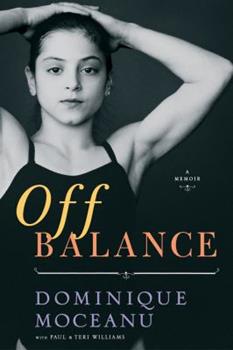
The third book I listened to is Dominique Moceanu‘s memoir, Off Balance. It focuses as much on her forming a connection with the estranged sister her parents gave up for adoption as it does on Dominique’s gymnastics career. Overall, I enjoyed this one purely for the stroll down memory lane. Dominique and I are the same age, and I remember following the Summer Olympics on television in ’96, the year when she and the other members of the Magnificent Seven won gold in Atlanta. Moceanu does include some details about her training with Bela and Marta Karolyi, the two coaches who trained champions at their Texas ranch for generations. She alleges abuse, and I believe her. It’s competitive gymnastics, a cutthroat world that focuses more on medals than anything else. Moceanu survived physical and emotional abuse at the hands of her father, who pressured her to perform and moved his family across the country several times for her gymnastics training. There’s also an unresolved subplot involving him attempting to hire hitmen to kill both Moceanu’s friend and her coach. (!!!)

Every one of these books is worth a listen.

Big Sky, Episode 3 (“The Big Rick”)

My boyfriend and I have started watching this show together on Tuesday nights. It’s a fun time for us. I’d forgotten how much fun it is to talk about your favorite shows with your friends. In college, I used to watch Felicity together with a friend on the phone while I lay across the single bed in my dorm and she laughed through the receiver into my ear. Fun times.

Anyway, in this episode Grace and the other two captives are able to bang a loose board long enough to allow Grace to squeeze out of the trailer. It was a pretty improbable scene, at least to my boyfriend and me. If Grace could crawl out, then why couldn’t the other two? Anyway, Grace crawls through the loose metal sheeting, and it somehow clamps back tightly together. She cant find the door that the deranged trucker uses to enter and exit the bunker, but she can find a pipe with flowing water in it. She frantically tears up the floor and finds a way into the ground just before Ronald the insane trucker bursts in and dives into the underground pipe in pursuit of her. The ground caves in between the two of them, and Ronald barely makes it out. He can’t tell if Grace has been buried alive or if she managed to crawl through to the other side.

Meanwhile, the other two girls are still trapped inside the metal trailer. Danielle screams frantically after hearing the cave-in.

Ronald confesses to Legarski that Grace is either buried alive underground or else she escaped and could be free on the other side. A peeved and worried Legarski takes off in some sort of fancy four wheeler that has a small storage thingy on the back of it just large enough to transport a body…

By this time, the drama is so intense I’m on the edge of my seat. Go, Grace, go!

Photo credit: ABC.com

Grace manages to climb completely through the underground drainage and out into the woods. She finds a fisherman in a stream and frantically tells him that she was being held captive and that others are still in captivity. Help her, please!

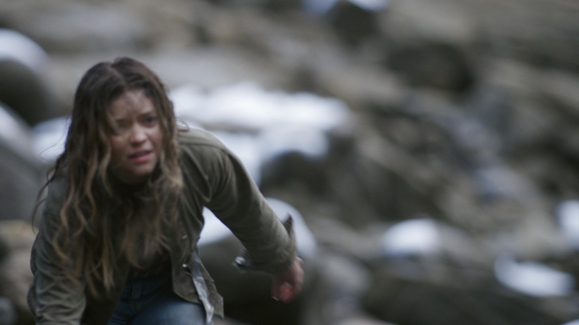
The fisherman looks like he wants to take her to safety, but lo and behold, Legarski spots them and pulls out a nifty crossbow and shoots the fisherman dead right in front of Grace. Wow, this is only episode three and he’s already stacked up two bodies. Grace is horrified, and Legarski, whom Grace doesn’t know and has never seen before until that point, attempts to manipulate her into thinking the fisherman was dangerous, and he even tells her he overheard her use the word “kidnap” or “captive,” and that he thought the fisherman might harm her. Grace doesn’t buy what Legarski is selling, so she shoves a fishhook into his cheek and tries to run away. Halfway up an incline littered with boulders, she’s slowed by the arrow Legarski shoots into her leg. Still, she tries to run, and he responds with an exasperated, “Are you kidding me?!” before piercing her leg with a second arrow. She appears to pass out, and he tosses her on the back of his four-wheeler.

Legarski wraps the fisherman in a plastic bag held together with duct tape. Why does he just happen to have these things on hand? How many folks will this man kill? Certainly, the fisherman’s family will scout that location in a future episode to search for their missing loved one. Legarski throws the fisherman’s body into some green, sulfur-y lake that looks like it belongs in my nightmares. Seriously, the water looks like it’s bubbling, and smoke rises above it like in those pictures you see of witches’ cauldrons.

Pic courtesy of ABC

Meanwhile, Danielle, after hearing the ground cave in and possibly kill Grace, has dried her tears. Rather than trying to squeeze out of the hole Grace climbed out of, Danielle and Jerrie share a heart-to-heart about bigotry. Jerrie admits her parents put her in therapy when she told them she was a girl. When the therapy failed to “cure” Jerrie, her parents put her out of the house when Jerrie was just fourteen years old. Jerrie reveals all of this to Danielle and they squeeze hands rather than try to escape. I appreciated that scene, but it felt like it came at the wrong time. The girls should be trying to jailbreak just then.

The best dialogue of the episode comes from Jerrie, who asks Legarski, “Aren’t you here to help us?” when he carries an injured and duct taped Grace back to the trailer dungeon while clad in his policeman’s uniform.

I’m much less invested in what Cassie and Jenny are doing. All they know so far is that they have a bad hunch about Legarski, especially after he fails to get them a search warrant for the church/cult compound that Cody was en route to on the day of his disappearance. Jenny does visit the compound, a place where young women are courted by much older men. The church security footage shows, of course, that Cody was never on the campus there at all. Jenny and Cassie are no closer to finding Cody than in the last episode. I don’t even care about Cody’s death nearly as much as I do about the kidnapped girls’ fates.

See you next week, Montana peeps.

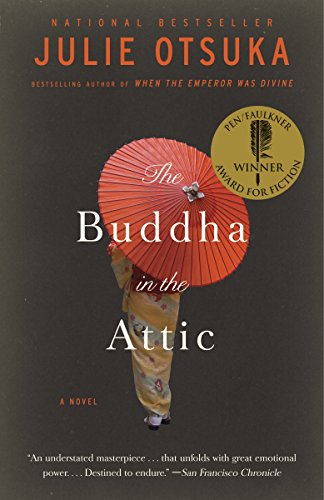
The Buddha in the Attic

Julie Otsuka’s book, The Buddha in the Attic is the story of a group of Japanese picture brides who come to America in the early 1900s to marry a group of Japanese men. The women have never met their husbands before they arrive, and many are gypped into marriage by lying men who claim to have a good, middle-class life, but instead are struggling financially and need someone to help run a farm or do other manual labor. We also get to see how the brides’ American-born children assimilate into American culture. Throughout the story, the wives also contend with racism directed at them from whites, especially after Pearl Harbor. I think the internment of Japanese-Americans during the second world war is something that doesn’t get as much attention in history classes as it deserves, though hopefully this is changing now. When I was a high school and college student 15-25 years ago, we mostly focused on what was happening in Europe during that war, and I don’t remember ever being taught that Japanese people right here in America were being unjustly held as prisoners. Kudos to Julie Otsuka for teaching me that and allowing me to give that knowledge to my American literature students this semester when I taught this gem of a book for the first time. Some students were put off by the book’s narrative style. It’s told in a plural first-person. After a while, I got used to it and found the repetition rather poetic. I’ll teach it again next semester. 

Big Sky, Episode 2

Photo credit: ABC TV

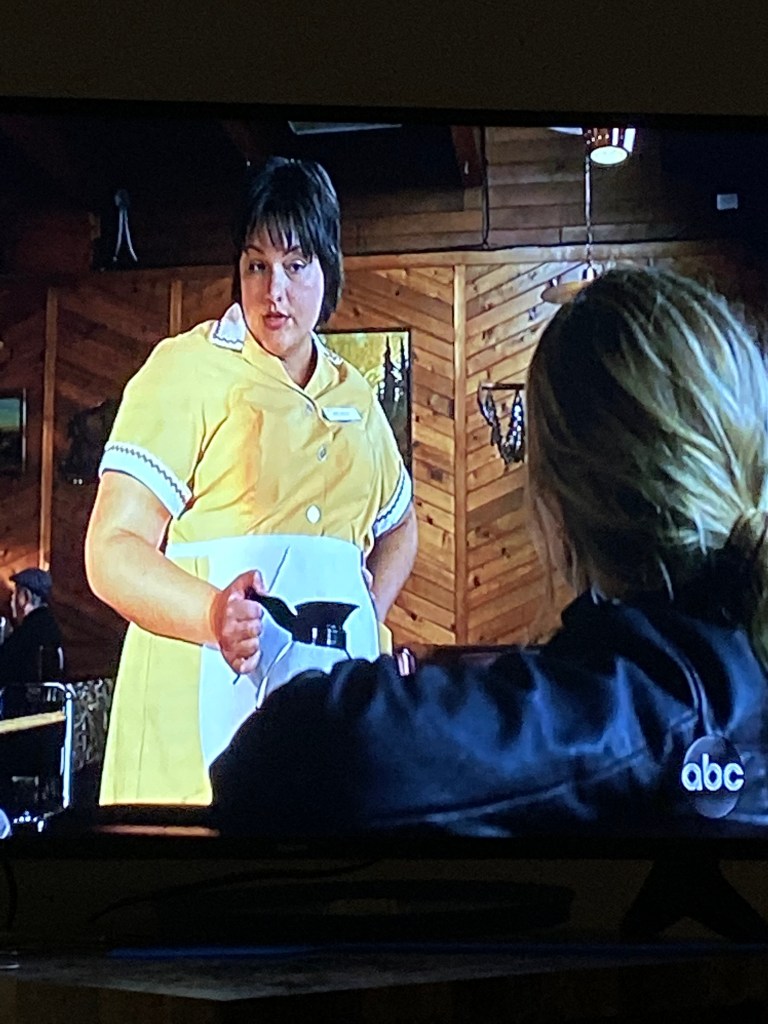
In this episode, Ronald the-trucker-guy has our three kidnapped females in a big, metal storage trailer underground. He conspires with Legarski, the highway patrol guy, about what to do next. Legarski tells him that they can possibly sell the prostitute simply because he thinks no one will be looking for her, but he doesn’t think they can sell the other two because they look too wholesome and college-bound and that their families and friends will look for them. He turns out to be wrong later in the episode when a waitress at the local diner tells Jenny that she misses her friend Jerrie the prostitute.

Photo credit: ABC TV

Danielle catches on that Jerrie is trans. She flat out asks her if she has a penis. Jerrie confirms that she does. Later, Ronald takes Jerrie out of the metal trailer and forces her to undress and wash herself. He tells her he’ll be sending her elsewhere, which I take to mean he intends to sell her to Canada. However, once he sees her naked he decides not to send her away. I knew she was either trans or intersex in episode one, though I wondered if any of her clients ever caught on to this. Imagine if she were to solicit a man under the guise of being female. Wouldn’t that customer be disappointed to see that she has a penis? Also, I was cool with Ronald not realizing she was trans and only discovering it when he sees her in the shower, especially since she could definitely pass as a female, but I thought the moment where she pulls off her wig was a bit much. Reminds me of those movies and shows where the man in drag always takes his hair off to show that he’s really a guy. Feels unnecessary and silly to me. Hair is not what makes a person look male or female. Her strong jawline is what made me wonder if she was intersex or trans.

Photo credit: ABC TV

Grace and Cassie seem to be the two smart people on this show. Grace tries to conspire with the others to devise a plan to get them out of the trailer, though she loses her temper and head butts Ronald and only makes him angrier. At least she thinks and tries, though. The other thinker is Cassie, the detective that Legarski is sure to point out is “beautiful and black,” which, according to him, makes her a rarity in Montana. Cassie is smart in that she’s intuitive enough to realize something is not quite right about Legarski. He creeps her out and she knows from just a few minutes alone with him that he must be in on the disappearances. Still, smart as Cassie seems, she also makes some silly choices. First, she lets Legarski know that she suspects a long haul trucker might be involved in the disappearances, a detail that immediately puts Legarski on high alert. Cassie also makes the mistake of sitting out in her car to call the office secretary and tell her something isn’t right about Legarski, and she does this instead of just driving the hell outta there. Lucky her, though, Legarski realizes he can’t make her disappear in the way he did Cody, or else people will know for sure he’s in on the disappearances.

Ronald’s relationship with his mother looks crazier and crazier. In this episode, he climbs into bed with her at night because he can’t sleep. This is definitely appropriate behavior for an elementary school kid, but not for a 38-year-old man.

Photo credit: ABC TV

I’m waiting for his mother to realize that Ronald is into something illegal. Does Ronald actually carry any goods in his big truck, or is it only used to transport his kidnapping victims? Does he fail to bring home a regular check? If so, his mother would definitely notice these things.

I think the writers are getting the language wrong at times. Both Ronald and Legarski use “fixing to” at some point in episode two. I’ve never been to Montana, but I’m willing to bet my house that “fixing to” isn’t a common phrase around there. It’s a Southern dialectical phrase, at least I think it is. Perhaps the writers are Southern and trying to make these men sound folksy but are choosing the wrong phrasing at times. “Easy peasy” was a phrase that fit, but not “fixing to.”

There’s some lovely singing throughout the episode, especially at the end when the three captured women sing “Down in the River to Pray,” but the song doesn’t fit the setting. The song reminds me of Appalachia, and I would also associate it with the Southern church hymns I grew up with before I would associate it with Montana. But maybe I’m reading too much into it. Folk songs are folk songs. People around the country probably know that song, whether they’re Southern or not. Still, I love the song, and the cast “sounded” lovely as they lip-synched it.

Big Sky (Episode 1)

This site has mostly focused on reviewing books I’ve been reading. Tonight, I saw the premiere of Big Sky, a television series based on a book series by C.J. Box. I haven’t read the books, but the teaser for the pilot episode of the show intrigued me.

One thing I really like is that the show includes an androgynous character. The character, who appears to play/pass as a woman, is a prostitute who climbs into the cab of a trucker at a truck stop. The poor thing. Turns out the trucker is a psychopath who tases her and puts her in the trailer of his truck. I really hope the character survives and continues in this series. I think it’s so cool when shows include LGBTQ characters. It shows that television-land acknowledges the diversity of the world and of human experiences. Bravo!

There are two other plot threads. The first is the story of two teenage-ish sisters on a long road trip together. When they don’t show up at their destination, the boyfriend of one of the girls gets his father, Cody, a private investigator, involved. Cody, (played by Ryan Phillipe) gets in contact with a state trooper. Spoiler Alert: the trooper is in cahoots with the crazy trucker guy who has kidnapped the girls and the prostitute. The trooper shoots Cody the PI at the end of the first episode and then gets on the phone to call the trucker and ream him out about how sloppy he’s gotten.

The other plot thread involves Cody the PI and his two women. One woman is his estranged wife, Jenny (played by Katheryn Winnick). The other woman is Cassie, (played by Kylie Bunbury) their friend and partner at the private investigator business they run. The two women are both sleeping with Cody, and one thing I hated about the pilot was when the two women get into a brawl in a bar over Cody. So annoying. Please, writers, give these two women something to do in the next episode besides fight over a man.

Other things I disliked/hated:

–The psycho trucker has a nagging mother, which feels like something I’ve seen too often. The mommy issues remind me of Norman Bates.

–The young girls alone on a deserted road remind me of so many slasher movies. On film, nothing good ever comes out of car trouble at night in a wooded area. The minute the car breaks down, the audience immediately knows what to expect.

I’ll be back next week.

Photo credit: Deadline.com

Up a Road Slowly

Up a Road Slowly by Irene Hunt was a childhood favorite of mine. This past weekend I listened to it while shopping and working around the house. Wow! I can now say that Up a Road Slowly will remain on my all-time favorites list. It’s the sort of coming-of-age novel I’ve always loved. A young person grows and changes as she struggles through everyday life problems. It begins after the death of her mother when seven-year-old Julie Trelling goes to stay with her aunt in the country. She must contend with homesickness as she’s living near her father but no longer with him. Her brother, Chris, goes away to boarding school, and their older sister marries young. In the country with her aunt Cordelia, Julie survives her first romantic relationship, learns painful lessons about class differences and bullying, and even learns how to write fiction from her alcoholic uncle. The characters are flawed, yet I rooted for them. This is a book I’d recommend to anyone, regardless of age.

65954

Blog at WordPress.com.

Up ↑