Last Summer on State Street

I’m about halfway through Last Summer on State Street and I’m enjoying it because of the honest narration and the wisdom of the adult narrator looking back on her harrowing childhood. It’s the story of a 12-year-old black girl named Fe Fe who lives in a housing project in Chicago with her three friends: Precious, Stacia, and a newcomer named Tonya. The story is set in 1999, and the girls’ apartment building is likely to be demolished due to neighborhood gentrification. The girls and their families dodge bullets and witness violence. Fe Fe has a brother who is into guns and is being recruited by a gang. Her friend Tonya is being taken advantage of by grown men, and Tonya has a drug addicted mother. Stacia is a gang leader’s daughter, so she’s seen as dangerous by the kids around them. The novel is heartbreaking and feels true. I know these issues can be triggering, but if you can handle violence, gangs, crimes against children, and poverty, give this one a read.

I’m listening to the story on Hoopla Digital, and the opening paragraphs drew me in. I love the sense of place and time and the fact that these girls bond over something as innocent as double Dutch. The characters are flawed, and I feel so much sympathy for them. I especially like Fe Fe’s mother, a single parent who stresses the importance of good behavior and deportment.

The author is Toya Wolfe, and this is her debut work. This is an #OwnVoices read.

#LastSummerOnStateStreet

Girl Talk #6: The Ghost of Eagle Mountain, or The One in Which Native American History Is Distorted by Whites

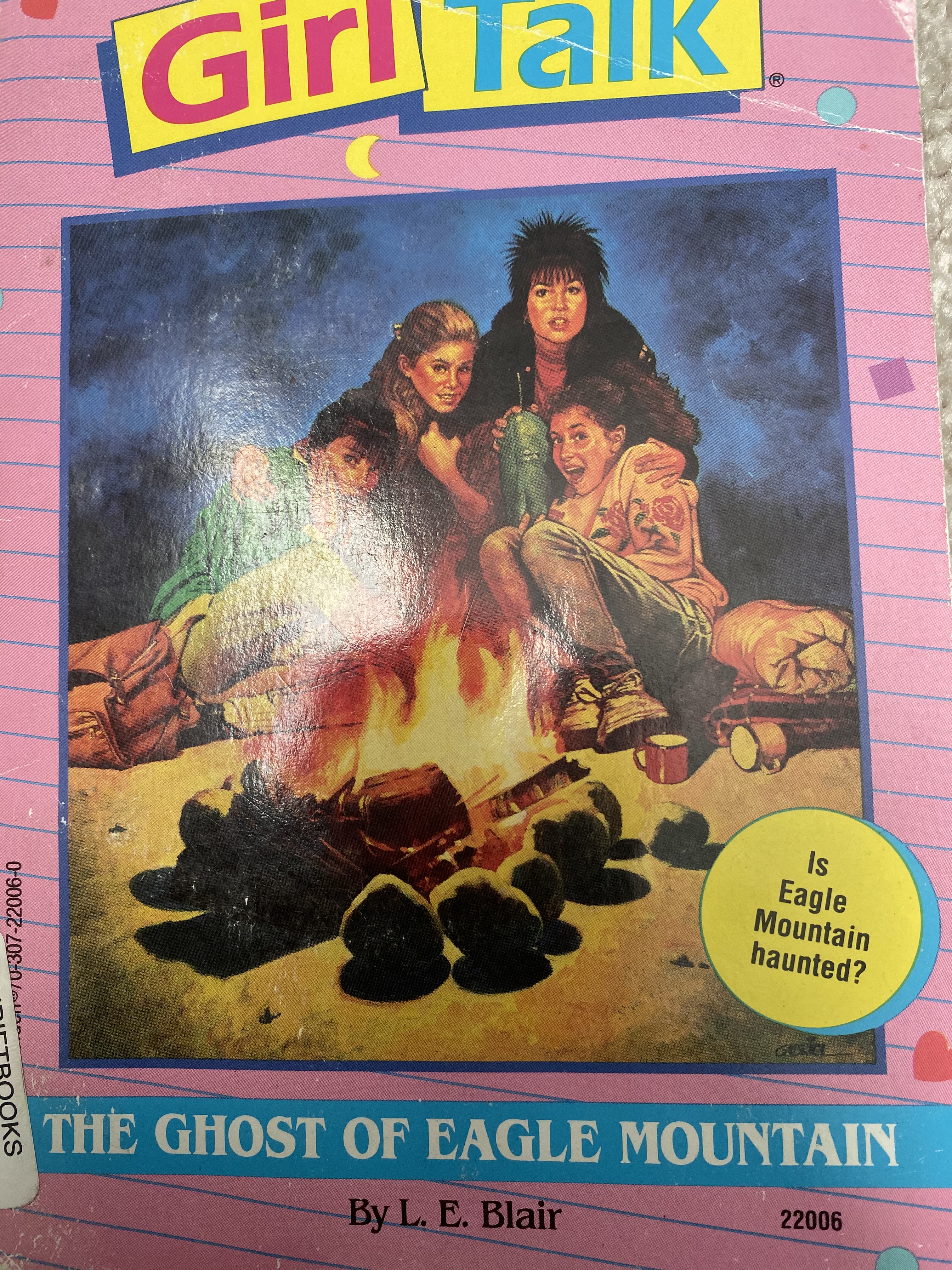
And now we come to The Ghost of Eagle Mountain. As a child reader, this one and Face Off! were my favorites of the entire series. Told from Allison’s perspective, this book focuses on a skiing trip that she and her fellow seventh-graders take to Eagle Mountain (which I recently learned is a real place in Minnesota). Allison and the gang find out that they are rooming together, but the other four people in their cabin will be vain, snobby, Stacey “the Great” Hansen and her friends Eva, Laurel, and B.Z.

From the first mention of the trip to Eagle Mountain, Allison has a dreadful feeling that something terrible will happen. Then, she inexplicably finds a loose eagle feather in her locker at school. Allison’s grandma later tells her a story about a man named Eagle Feather who was one of their family’s tribe, the Chippewa. He was separated from his wife and child when the Indians were relocated to a reservation. The legend says that he haunts the area around Eagle Mountain, searching for his lost love.

On the way to Eagle Mountain, the school bus breaks down, and Allison can’t shake the ominous feeling of dread. Allison and her friends do have a good bit of fun learning to ski from their cute instructor. However, when given the task to go on a scavenger hunt on skis, the girls get lost after trying to take a shortcut. This feels like something that would almost never happen in real life. Chaperones are always right around the corner on school trips. It’s hard to believe they’d let a bunch of groups go off on their own through the woods on skis. Allison and company get sooo lost. They wind up crossing a stream and then skiing near a frozen river.

Inexplicably, the girls find their way back to the trail. Or, I guess I should say that they stumble onto the ski lodge by dumb luck.

After dinner, Ranger Rob begins to tell all the 7th graders a ghost story, and Allison realizes it’s the story her grandma told her about Eagle Feather. However, Rob’s story is completely different. He calls Eagle Feather by the name of Flying Eagle and says that Flying Eagle was a menacing Indian who liked to attack white settlers. He says that now that Flying Eagle is dead he roams Eagle Mountain in search of his next victims. Allison, of course, becomes enraged. I remember feeling upset, too, while reading this as a middle-schooler. I didn’t have the language to describe it back then, but I just knew and understood what an injustice it was. Now I see that this is a prime example of history being mistold and distorted by the victors. God only knows how many real-life instances we have of this. In grad school a white classmate of mine asked why we need to teach books by a diversity of authors. My best answer is that diverse reading helps us see things from multiple perspectives. When I teach slave narratives in American lit classes, students are often shocked by the stories. They grew up knowing that slavery existed in this country, but many history books don’t go into much detail about the gruesome, inhumane ways slaves were treated. That’s why we need diversity. We need for people to read multiple perspectives in order for them to understand. Same is true for Native Americans and settlers and the long and painful history about what happened between them.

One issue I have with this book is that things are tied up too neatly. Allison ventures off into the woods because she thinks she hears the ghost of Eagle Feather moaning. She gets lost but sits down and sings to the ghost. Her voice quiets the wind and the moaning. Then, an eagle feather drifts down from the sky. She takes this as a sign that the ghost is now at rest. Too easy. Then, her friends find her after she’s only been lost for about ten minutes. Too easy.

Don’t get me wrong. I still like this book because I like its message about giving a voice to oppressed people. However, I guess I was expecting a bit more complexity, which might be too much to ask of a book for middle-graders. Anyway, it’s still a good book and one I’d recommend to school kids.

Grade: A-

Ghost of Eagle Mountain

Girl Talk #11: Mixed Feelings

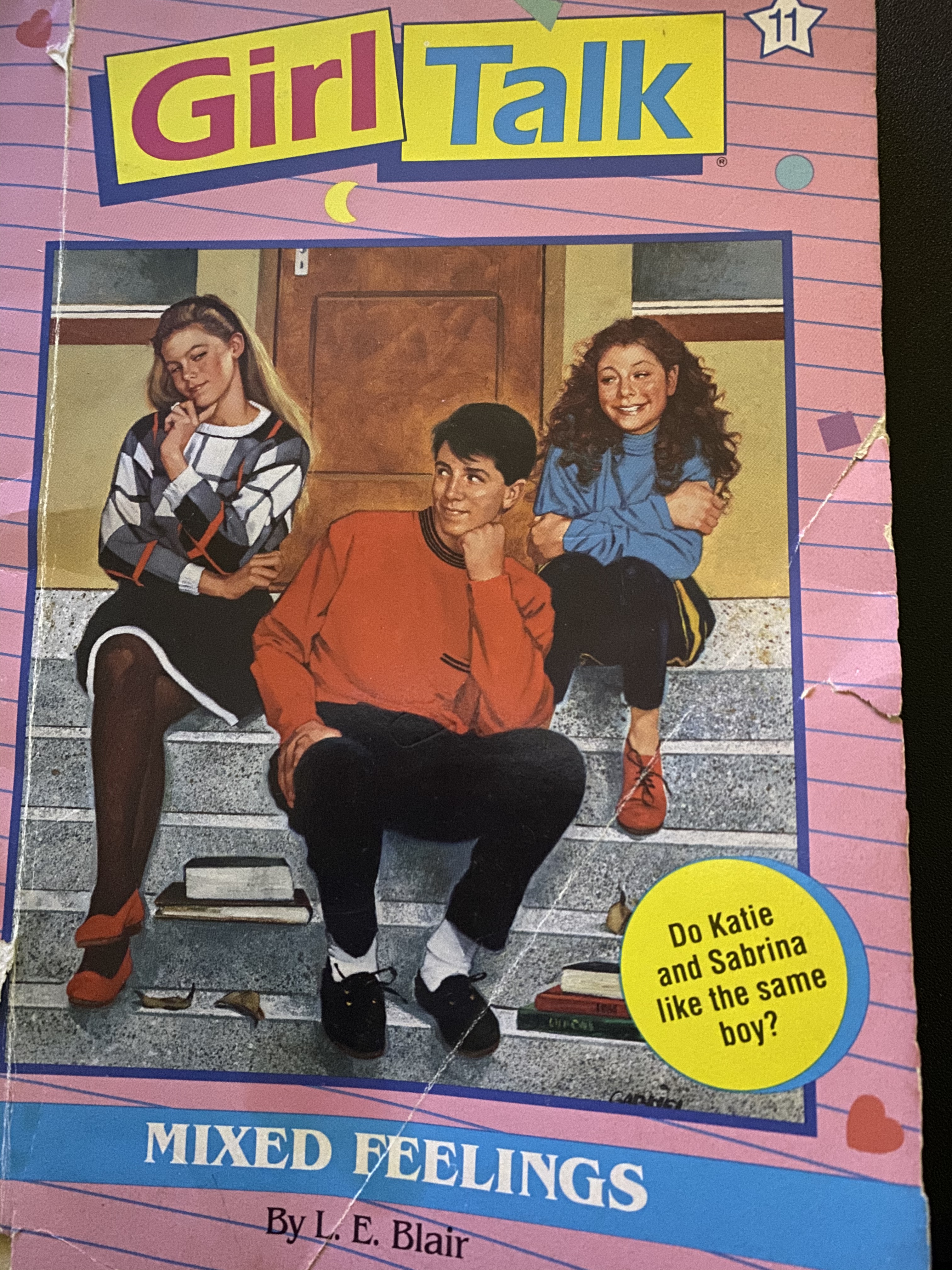
This one focuses on Katie Campbell. The basic plot: Katie’s mother begins dating a newcomer to town, a man whose son plays on the hockey team with Katie at school. The son’s name is Michel, and the father is Jean Paul, and the twosome hail from Canada and have heavy, French Canadian accents. The accent is described by both Katie and Sabs as a French accent, which confused me. Would it really be called a French accent if they aren’t from France? As a child when I read these books I didn’t understand the difference between a race and an ethnic group, and I thought French Canadians were a different category of white and I even questioned their whiteness, and I believe the reason I did this is that the author makes mention of how dark Michel’s hair and eyes are, which made me think that he looks like a dark-featured Native American or a brown Hispanic. I’m not sure if this is what the author intended. I come from a small town in Georgia where most of the people are whites descended from Scotch Irish and have lived in this country for many generations. I didn’t hear too many foreign accents in my town and had never met any French or Canadian people. Reading these books as a middle schooler helped to introduce me to people outside my town, even though those people are fictional. Another great reason to read is that it opens people up to varying perspectives. I realize that a white writer might think of other white people as dark. Whereas, I’m a dark-skinned Black woman and rarely think of most whites as dark at all. In fact, if you’re past a certain shade, I question if you’re truly white.

Anyway, here are a few notable things that happened in this one:

  1. Katie’s mom meets Michel’s dad, Mr. Beauvais, when he applies for a mortgage at the bank where she works. Later in the series it’s revealed that the Beauvais family is stinking rich, so why are they applying for a home loan? Why wouldn’t they just pay cash?
  2. The title is a bit misleading. Katie doesn’t have mixed feelings about Michel. She likes him as a friend and doesn’t really think of him as more than that. She doesn’t spend much time thinking about him at all. Instead, she wants to win the big hockey game and make the playoffs. She also worries when her mother gets a makeover and announces that she’s seeing Jean Paul, and this is because he’s the first man she’s dated since Katie’s father passed away three years ago. Katie doesn’t have romantic feelings for Michel, and in fact she gets excited when she finds out that Michel thinks her friend Sabrina is cute. However, the blurb and cover photo lead you to think that there’s a love triangle between Katie, Michel, and Sabrina:
Mixed Feelings

3.  Katie changes clothes in a separate locker room away from the boys. Scottie Silver sticks his eye into a peephole and giggles. Katie squirts him with water and has a chuckle about it. If I were her,  I’d be horrified that a group of boys has a peephole into my private changing space. Katie doesn’t even tattle to the coach or report it to anyone to get the hole plugged.

4.   Remember how Scottie treated Katie so heinously in book #2 when she tried out for the team? He teamed up with the guys and beat her up on the ice by playing super rough. He even taunted her about it afterward. In this book, Scottie again shows jerk behavior. Jealous that Michel is a better hockey player than him and jealous that Katie hangs around with Michel, Scottie acts like a jerk and freezes Katie out by sulking, yelling at her, and staring off into the distance. I get that he’s a middle school boy and perhaps his age makes him prone to doing stupid things, but wouldn’t it make better sense for him to just ask Katie if she’s into Michel rather than mistreat her? After Katie becomes injured in a hockey match, Scottie starts to play rougher toward the other team as a way of lashing out and getting rid of his frustration about her injury, and this behavior gets him called for a penalty, which puts the team in danger of losing the big game. However, Scottie gets out of the penalty box in time to assist in the game-winning goal Michel scores. Scottie does eventually apologize to Katie for being so mean to her, and she instantly forgives him.

5.   Sabs, Randy, and Allison all act strangely and mysteriously around Katie. For instance, they stop talking whenever she walks into the room. Her birthday is coming up, so it’s obvious to the reader that they’re sneaking behind Katie’s back to plan a surprise party. Katie doesn’t catch on, and instead she becomes hurt and worried that her friends are keeping secrets from her.

6. This book reminds us how physically tough ice hockey can be. Katie is injured in this one to the extent that she needs eight stitches in her chin. If she were my child, I’m not sure I’d let her continue to play hockey, and while her mother dotes on her and babies her a little after the injury, there’s never a mention of Katie giving up the sport.

7. For me, the best part about the book is reading about Katie’s reactions to her mother dating Jean Paul. Even though her father’s dead, Katie feels that her mother somehow shows disloyalty to his memory by dating another man. Neither Katie nor Emily want Mrs. Campbell to date, but they cannot say they dislike Jean Paul. He treats them cordially and makes Mrs. Campbell happy. Also, the mother wants Katie and her sister Emily to be happy and is nervous to introduce them to Jean Paul for the first time. Later in the series we’ll see both families struggle as members of a blended family, which is a real-word issue that I think a lot of readers connected with.

Come back later this week for my recap of The Ghost of Eagle Mountain. I remember loving that one when I was a child, and I hope I still enjoy it now.

The Long-Awaited Conclusion to the Logan Family Series

I’ve loved Mildred D. Taylor’s books since I was a child. In eighth grade, I listened as my Georgia history teacher, Mr. Benton, read aloud from Roll of Thunder, Hear My Cry each week. I fell in love with Cassie Logan, the book’s intuitive, beautiful protagonist. The other books I read as a child featured mostly white female protagonists. Sure, there was Allison Cloud, the bookish Native American girl from Girl Talk, and there were Claudia Kishi and Jessi Ramsey from The Babysitter’s Club, but other than those few the characters in the books I read were mostly white.

The white authors I read frequently reflected on how blue a character’s eyes were, and I could always tell what the authors’ beauty standards were. The authors of the Sweet Valley series loved long blonde hair and tan skin (but not black skin) and a size six body. In the stories I write, the characters don’t have blue eyes, and I don’t favor the ultra-thin beauty standard either. I often struggle to describe my beautiful black female characters without using food comparisons. Yes, that’s a thing. I’ve read books by writers, both black and white, who say a black woman is peanut butter brown, has skin that shines like pudding, or is the color of a pecan. Food. Food. Food.

Reading a book series in which the black female telling the story doesn’t suffer low self-esteem is something that gave me hope as a child. Stop for a moment and consider the most popular dark-skinned black women in literature. There’s Celie in The Color Purple, the narrator of Salvage the Bones, and of course Pecola Breedlove in The Bluest Eye. Though there’s hope at the end of The Color Purple, overall Celie and the other protagonists from the aforementioned books are stepped on, shat on, and all but tarred and feathered by their tormentors.

Then we have Cassie Logan, a young woman who is smart and hard-working and has a life that, even in Mississippi in the 1930s-1940s, isn’t completely hopeless. I’m proud of Cassie Logan, proud as if she were my own daughter. I love how her family sticks up for one another and stays together. I can write beautiful black females because another author came before me and wrote Cassie Logan and did it like a boss. Mildred Taylor didn’t write black women with white readers in mind. She didn’t say that Cassie was pretty “for a colored girl” or that she had white features, like thin lips or a thin nose to make her somehow more palatable or attractive to white people.

Today, I went to Barnes & Noble and bought the last book in the Logan family series: All the Days Past, All the Days to Come. (This says a lot because I never buy those expensive ass brand-new hardcovers–the last one I bought was Harper Lee’s second novel–and I prefer to buy used books cheaply.) For the next week, I will catch up with Cassie Logan, who last narrated the series in a book released in 1990. Yes, it’s been thirty years since The Road to Memphis was first published, and the other books Taylor has written since then were both prequels and not narrated by Cassie. This new book was not only a long time coming, but one I did not expect until last summer when I saw it available for a pre-release purchase on Audible. For years, I’d thought Taylor had passed away. I kept wondering if she’d died before finishing the series. For years, I’ve wanted to know what became of Cassie’s family after WWII. Did her brothers serve in the armed forces? Did Cassie pursue her dream of becoming a lawyer? I wanted to know if Cassie would marry the lawyer she met in 1941 or if she’d marry Moe, the sweet man from her community. Now, sitting here typing this, with the newest and last installment of the beloved series, I wonder, will this book, like all my favorite books, break my heart?


Blog at WordPress.com.

Up ↑