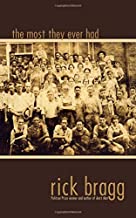
What I’m Reading Now: The Most They Ever Had by Rick Bragg

Today I finished Rick Bragg’s nonfiction book, The Most They Ever Had, which is about cotton mill workers in northeast Alabama in the 20th century. The book is a series of vignettes that include stories of mill life. It takes you on a journey through working conditions before and after textile workers’ unions existed. I quite liked this book, but mostly for personal reasons. One reason is that it reminds me of the small Georgia town I grew up in–Commerce, GA (pop. approx. 6,000). We had an old cotton mill there called Harmony Grove Mill. It shut down somewhere near the century’s end. We also had another cotton mill in Jefferson, Georgia, the town where I attended high school. My mother’s brother, Toby, lost two fingers working in the Jefferson mill, and my oldest brother worked there one summer when he came home from college. Both my parents were poultry plant workers, but they picked cotton when they were growing up back in the ’50s and ’60s.

The other thing I like about Bragg’s book is that he reads the audio version himself. At times throughout, his voice catches ever so slightly, as if he’s struggling to choke back tears. He’s writing not just the personal histories of the mill workers he’s interviewed, but his own family history. His brother worked in an Alabama textile mill before it shut down. His mother picked cotton for years. Bragg has taken his own personal history and combined it with the histories of others, and added a bit of research to create something akin to a patchwork quilt.

Bragg’s book is written with nostalgia, which I’m not quite sure makes any sense. Why be nostalgic for a cotton mill? The pay was low. The job was often dangerous. And yet the book calls it the most they ever had. It reminds me a little of how some Southerners are nostalgic for the old South–a land of 90+ heat with no air conditioning, thick cotton fields, and race prejudice. Yet, sometimes when you hear an old Southerner speak of those days they will smile. I guess we all tend to romanticize childhood, regardless of what type of childhood it was.

My mother will often listen to audiobooks. When I first suggested The Most They Ever Had a few years back, she said it was too sad for her to finish reading it. I put it away myself without reading it because I was judging it based on her reading preferences. My mother hardly turns away from a sad book, so if she couldn’t finish it I didn’t think I’d be able to either. Still, I’m glad that I went back and finished listening to this one.
The Most They Ever Had


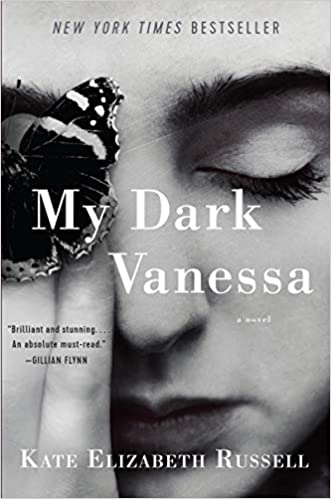
What I’m Reading Now: My Dark Vanessa

I started the audiobook of My Dark Vanessa by Kate Elizabeth Russell today. I got it free from the Hoopla app at the public library. If you’re a book lover who doesn’t have Hoopla, you should check with your local public library and ask if they have access to Hoopla. I’ve listened to a lot of good books on there so far, and you check them out the same as you would a regular library book. It’s free and easy.

As for My Dark Vanessa, I’m conflicted about this book, but I’m leaning more toward not liking it. It’s about a 15-year-old girl who has a sexual relationship with her 42-year-old English teacher. My major problem with the book is that so far it hasn’t surprised me. I’m more than five hours into it, which means I’m about 1/3 of the way through the book, and everything is turning out exactly the way I first envisioned it before I even started listening. Is there an unfair and unsettling power dynamic between the student and the teacher? Yes, there is. I also expected lurid details about their sex life, and it delivers on that as well. All these old binaries and clichés are on full display: powerful male vs. defenseless female, a younger and more naïve person juxtaposed with an older and sexually mature partner, and an older person who manipulates and controls the younger partner. The man is even so gross that he has big sweat stains under his arms. By comparison, the girl is much smaller and defenseless, barely coming up to his shoulder when they stand next to one another. He coaxes her into doing things she doesn’t want, which is exactly what I expected. So my big criticism so far is that the book plays into old hackneyed things we’ve seen before. It feels like the plot of a Lifetime movie. In fact, I’m almost certain Lifetime has more than one film about an older man pursuing an inappropriately young girl. He grooms her and manipulates her and then selfishly takes everything she will give. She’s so naïve that she thinks it’s up to her to give what he wants, even if it makes her uncomfortable and hurts her emotionally and physically.

My other big criticism is that the book feels much too long. The audiobook is over fifteen hours, and the physical copy of the book is close to four hundred pages. So far, I feel like I’m seeing some of the same things over and over again–him touching her, him asking permission after he’s already crossed a boundary, and her trying to hide the relationship from her parents and those at her school, etc. I feel like some of this stuff could just be told in summary instead of giving us all the details. Of course he has to tell her to keep quiet, so I don’t feel that we need to be reminded of this over and over again. The reader already knows that he’s risking his job, his reputation, and his freedom, and I don’t think all of this information has to be given to the reader so explicitly. It could be more nuanced. The novel, in my opinion, could be at least a hundred pages shorter.

On the positive side, I think the author is brave to take the risk of writing about this subject matter. Some readers will look at the synopsis and bypass the book altogether just because it sounds so sleazy and salacious. However, the author isn’t afraid to go there. She undoubtedly knows the material isn’t for every reader, yet she is brave enough to take the risk and go for it. I also like that it directly addresses the Me, Too movement. One of the teacher’s other young victims comes forward early in the book, which makes the narrator debate whether she should come forward in solidarity, and she even reflects on Me, Too and the cultural moment concerning victims coming forward to out their abusers. I guess that’s the only thing that’s making me want to keep reading this.  I want to see if our narrator, Vanessa, will stay quiet or have the courage to confront the teacher about what he’s done and also help prevent him from hurting someone else.

My Dark Vanessa

Blog at WordPress.com.

Up ↑