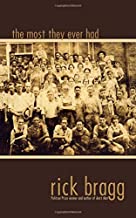
What I’m Reading Now: The Most They Ever Had by Rick Bragg

Today I finished Rick Bragg’s nonfiction book, The Most They Ever Had, which is about cotton mill workers in northeast Alabama in the 20th century. The book is a series of vignettes that include stories of mill life. It takes you on a journey through working conditions before and after textile workers’ unions existed. I quite liked this book, but mostly for personal reasons. One reason is that it reminds me of the small Georgia town I grew up in–Commerce, GA (pop. approx. 6,000). We had an old cotton mill there called Harmony Grove Mill. It shut down somewhere near the century’s end. We also had another cotton mill in Jefferson, Georgia, the town where I attended high school. My mother’s brother, Toby, lost two fingers working in the Jefferson mill, and my oldest brother worked there one summer when he came home from college. Both my parents were poultry plant workers, but they picked cotton when they were growing up back in the ’50s and ’60s.

The other thing I like about Bragg’s book is that he reads the audio version himself. At times throughout, his voice catches ever so slightly, as if he’s struggling to choke back tears. He’s writing not just the personal histories of the mill workers he’s interviewed, but his own family history. His brother worked in an Alabama textile mill before it shut down. His mother picked cotton for years. Bragg has taken his own personal history and combined it with the histories of others, and added a bit of research to create something akin to a patchwork quilt.

Bragg’s book is written with nostalgia, which I’m not quite sure makes any sense. Why be nostalgic for a cotton mill? The pay was low. The job was often dangerous. And yet the book calls it the most they ever had. It reminds me a little of how some Southerners are nostalgic for the old South–a land of 90+ heat with no air conditioning, thick cotton fields, and race prejudice. Yet, sometimes when you hear an old Southerner speak of those days they will smile. I guess we all tend to romanticize childhood, regardless of what type of childhood it was.

My mother will often listen to audiobooks. When I first suggested The Most They Ever Had a few years back, she said it was too sad for her to finish reading it. I put it away myself without reading it because I was judging it based on her reading preferences. My mother hardly turns away from a sad book, so if she couldn’t finish it I didn’t think I’d be able to either. Still, I’m glad that I went back and finished listening to this one.

The Most They Ever Had


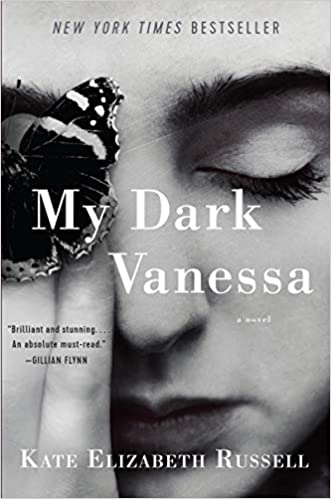
What I’m Reading Now: My Dark Vanessa

I started the audiobook of My Dark Vanessa by Kate Elizabeth Russell today. I got it free from the Hoopla app at the public library. If you’re a book lover who doesn’t have Hoopla, you should check with your local public library and ask if they have access to Hoopla. I’ve listened to a lot of good books on there so far, and you check them out the same as you would a regular library book. It’s free and easy.

As for My Dark Vanessa, I’m conflicted about this book, but I’m leaning more toward not liking it. It’s about a 15-year-old girl who has a sexual relationship with her 42-year-old English teacher. My major problem with the book is that so far it hasn’t surprised me. I’m more than five hours into it, which means I’m about 1/3 of the way through the book, and everything is turning out exactly the way I first envisioned it before I even started listening. Is there an unfair and unsettling power dynamic between the student and the teacher? Yes, there is. I also expected lurid details about their sex life, and it delivers on that as well. All these old binaries and clichés are on full display: powerful male vs. defenseless female, a younger and more naïve person juxtaposed with an older and sexually mature partner, and an older person who manipulates and controls the younger partner. The man is even so gross that he has big sweat stains under his arms. By comparison, the girl is much smaller and defenseless, barely coming up to his shoulder when they stand next to one another. He coaxes her into doing things she doesn’t want, which is exactly what I expected. So my big criticism so far is that the book plays into old hackneyed things we’ve seen before. It feels like the plot of a Lifetime movie. In fact, I’m almost certain Lifetime has more than one film about an older man pursuing an inappropriately young girl. He grooms her and manipulates her and then selfishly takes everything she will give. She’s so naïve that she thinks it’s up to her to give what he wants, even if it makes her uncomfortable and hurts her emotionally and physically.

My other big criticism is that the book feels much too long. The audiobook is over fifteen hours, and the physical copy of the book is close to four hundred pages. So far, I feel like I’m seeing some of the same things over and over again–him touching her, him asking permission after he’s already crossed a boundary, and her trying to hide the relationship from her parents and those at her school, etc. I feel like some of this stuff could just be told in summary instead of giving us all the details. Of course he has to tell her to keep quiet, so I don’t feel that we need to be reminded of this over and over again. The reader already knows that he’s risking his job, his reputation, and his freedom, and I don’t think all of this information has to be given to the reader so explicitly. It could be more nuanced. The novel, in my opinion, could be at least a hundred pages shorter.

On the positive side, I think the author is brave to take the risk of writing about this subject matter. Some readers will look at the synopsis and bypass the book altogether just because it sounds so sleazy and salacious. However, the author isn’t afraid to go there. She undoubtedly knows the material isn’t for every reader, yet she is brave enough to take the risk and go for it. I also like that it directly addresses the Me, Too movement. One of the teacher’s other young victims comes forward early in the book, which makes the narrator debate whether she should come forward in solidarity, and she even reflects on Me, Too and the cultural moment concerning victims coming forward to out their abusers. I guess that’s the only thing that’s making me want to keep reading this.  I want to see if our narrator, Vanessa, will stay quiet or have the courage to confront the teacher about what he’s done and also help prevent him from hurting someone else.

My Dark Vanessa

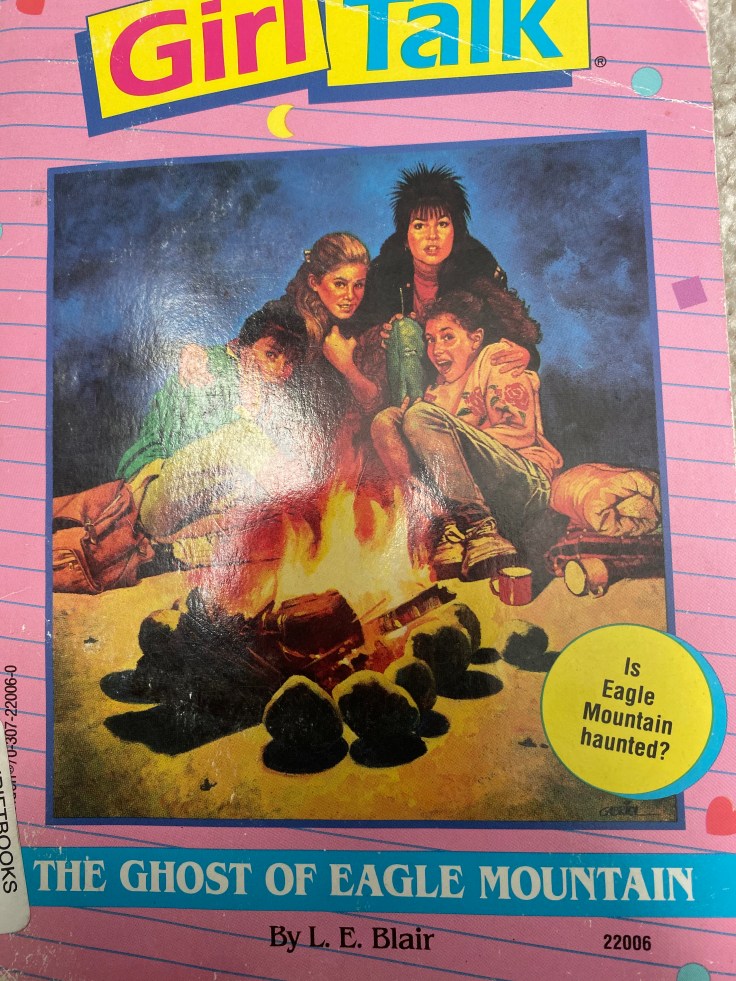
Girl Talk #6: The Ghost of Eagle Mountain, or The One in Which Native American History Is Distorted by Whites

And now we come to The Ghost of Eagle Mountain. As a child reader, this one and Face Off! were my favorites of the entire series. Told from Allison’s perspective, this book focuses on a skiing trip that she and her fellow seventh-graders take to Eagle Mountain (which I recently learned is a real place in Minnesota). Allison and the gang find out that they are rooming together, but the other four people in their cabin will be vain, snobby, Stacey “the Great” Hansen and her friends Eva, Laurel, and B.Z.

From the first mention of the trip to Eagle Mountain, Allison has a dreadful feeling that something terrible will happen. Then, she inexplicably finds a loose eagle feather in her locker at school. Allison’s grandma later tells her a story about a man named Eagle Feather who was one of their family’s tribe, the Chippewa. He was separated from his wife and child when the Indians were relocated to a reservation. The legend says that he haunts the area around Eagle Mountain, searching for his lost love.

On the way to Eagle Mountain, the school bus breaks down, and Allison can’t shake the ominous feeling of dread. Allison and her friends do have a good bit of fun learning to ski from their cute instructor. However, when given the task to go on a scavenger hunt on skis, the girls get lost after trying to take a shortcut. This feels like something that would almost never happen in real life. Chaperones are always right around the corner on school trips. It’s hard to believe they’d let a bunch of groups go off on their own through the woods on skis. Allison and company get sooo lost. They wind up crossing a stream and then skiing near a frozen river.

Inexplicably, the girls find their way back to the trail. Or, I guess I should say that they stumble onto the ski lodge by dumb luck.

After dinner, Ranger Rob begins to tell all the 7th graders a ghost story, and Allison realizes it’s the story her grandma told her about Eagle Feather. However, Rob’s story is completely different. He calls Eagle Feather by the name of Flying Eagle and says that Flying Eagle was a menacing Indian who liked to attack white settlers. He says that now that Flying Eagle is dead he roams Eagle Mountain in search of his next victims. Allison, of course, becomes enraged. I remember feeling upset, too, while reading this as a middle-schooler. I didn’t have the language to describe it back then, but I just knew and understood what an injustice it was. Now I see that this is a prime example of history being mistold and distorted by the victors. God only knows how many real-life instances we have of this. In grad school a white classmate of mine asked why we need to teach books by a diversity of authors. My best answer is that diverse reading helps us see things from multiple perspectives. When I teach slave narratives in American lit classes, students are often shocked by the stories. They grew up knowing that slavery existed in this country, but many history books don’t go into much detail about the gruesome, inhumane ways slaves were treated. That’s why we need diversity. We need for people to read multiple perspectives in order for them to understand. Same is true for Native Americans and settlers and the long and painful history about what happened between them.

One issue I have with this book is that things are tied up too neatly. Allison ventures off into the woods because she thinks she hears the ghost of Eagle Feather moaning. She gets lost but sits down and sings to the ghost. Her voice quiets the wind and the moaning. Then, an eagle feather drifts down from the sky. She takes this as a sign that the ghost is now at rest. Too easy. Then, her friends find her after she’s only been lost for about ten minutes. Too easy.

Don’t get me wrong. I still like this book because I like its message about giving a voice to oppressed people. However, I guess I was expecting a bit more complexity, which might be too much to ask of a book for middle-graders. Anyway, it’s still a good book and one I’d recommend to school kids.

Grade: A-

Ghost of Eagle Mountain

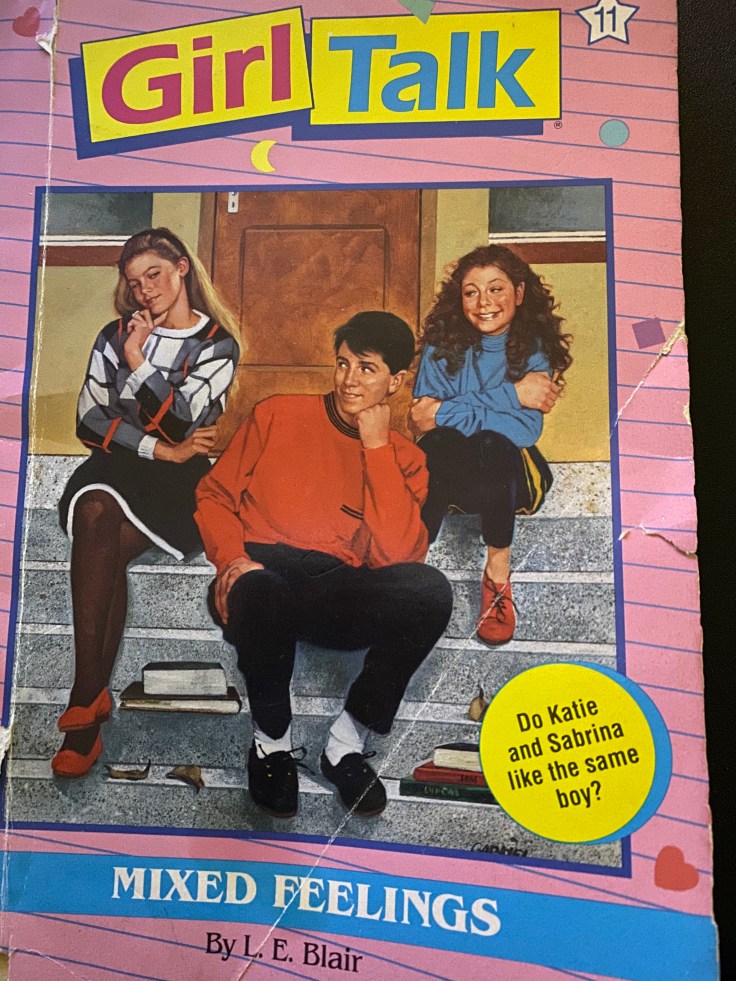
Girl Talk #11: Mixed Feelings

This one focuses on Katie Campbell. The basic plot: Katie’s mother begins dating a newcomer to town, a man whose son plays on the hockey team with Katie at school. The son’s name is Michel, and the father is Jean Paul, and the twosome hail from Canada and have heavy, French Canadian accents. The accent is described by both Katie and Sabs as a French accent, which confused me. Would it really be called a French accent if they aren’t from France? As a child when I read these books I didn’t understand the difference between a race and an ethnic group, and I thought French Canadians were a different category of white and I even questioned their whiteness, and I believe the reason I did this is that the author makes mention of how dark Michel’s hair and eyes are, which made me think that he looks like a dark-featured Native American or a brown Hispanic. I’m not sure if this is what the author intended. I come from a small town in Georgia where most of the people are whites descended from Scotch Irish and have lived in this country for many generations. I didn’t hear too many foreign accents in my town and had never met any French or Canadian people. Reading these books as a middle schooler helped to introduce me to people outside my town, even though those people are fictional. Another great reason to read is that it opens people up to varying perspectives. I realize that a white writer might think of other white people as dark. Whereas, I’m a dark-skinned Black woman and rarely think of most whites as dark at all. In fact, if you’re past a certain shade, I question if you’re truly white.

Anyway, here are a few notable things that happened in this one:

  1. Katie’s mom meets Michel’s dad, Mr. Beauvais, when he applies for a mortgage at the bank where she works. Later in the series it’s revealed that the Beauvais family is stinking rich, so why are they applying for a home loan? Why wouldn’t they just pay cash?
  2. The title is a bit misleading. Katie doesn’t have mixed feelings about Michel. She likes him as a friend and doesn’t really think of him as more than that. She doesn’t spend much time thinking about him at all. Instead, she wants to win the big hockey game and make the playoffs. She also worries when her mother gets a makeover and announces that she’s seeing Jean Paul, and this is because he’s the first man she’s dated since Katie’s father passed away three years ago. Katie doesn’t have romantic feelings for Michel, and in fact she gets excited when she finds out that Michel thinks her friend Sabrina is cute. However, the blurb and cover photo lead you to think that there’s a love triangle between Katie, Michel, and Sabrina:

Mixed Feelings

3.  Katie changes clothes in a separate locker room away from the boys. Scottie Silver sticks his eye into a peephole and giggles. Katie squirts him with water and has a chuckle about it. If I were her,  I’d be horrified that a group of boys has a peephole into my private changing space. Katie doesn’t even tattle to the coach or report it to anyone to get the hole plugged.

4.   Remember how Scottie treated Katie so heinously in book #2 when she tried out for the team? He teamed up with the guys and beat her up on the ice by playing super rough. He even taunted her about it afterward. In this book, Scottie again shows jerk behavior. Jealous that Michel is a better hockey player than him and jealous that Katie hangs around with Michel, Scottie acts like a jerk and freezes Katie out by sulking, yelling at her, and staring off into the distance. I get that he’s a middle school boy and perhaps his age makes him prone to doing stupid things, but wouldn’t it make better sense for him to just ask Katie if she’s into Michel rather than mistreat her? After Katie becomes injured in a hockey match, Scottie starts to play rougher toward the other team as a way of lashing out and getting rid of his frustration about her injury, and this behavior gets him called for a penalty, which puts the team in danger of losing the big game. However, Scottie gets out of the penalty box in time to assist in the game-winning goal Michel scores. Scottie does eventually apologize to Katie for being so mean to her, and she instantly forgives him.

5.   Sabs, Randy, and Allison all act strangely and mysteriously around Katie. For instance, they stop talking whenever she walks into the room. Her birthday is coming up, so it’s obvious to the reader that they’re sneaking behind Katie’s back to plan a surprise party. Katie doesn’t catch on, and instead she becomes hurt and worried that her friends are keeping secrets from her.

6. This book reminds us how physically tough ice hockey can be. Katie is injured in this one to the extent that she needs eight stitches in her chin. If she were my child, I’m not sure I’d let her continue to play hockey, and while her mother dotes on her and babies her a little after the injury, there’s never a mention of Katie giving up the sport.

7. For me, the best part about the book is reading about Katie’s reactions to her mother dating Jean Paul. Even though her father’s dead, Katie feels that her mother somehow shows disloyalty to his memory by dating another man. Neither Katie nor Emily want Mrs. Campbell to date, but they cannot say they dislike Jean Paul. He treats them cordially and makes Mrs. Campbell happy. Also, the mother wants Katie and her sister Emily to be happy and is nervous to introduce them to Jean Paul for the first time. Later in the series we’ll see both families struggle as members of a blended family, which is a real-word issue that I think a lot of readers connected with.

Come back later this week for my recap of The Ghost of Eagle Mountain. I remember loving that one when I was a child, and I hope I still enjoy it now.

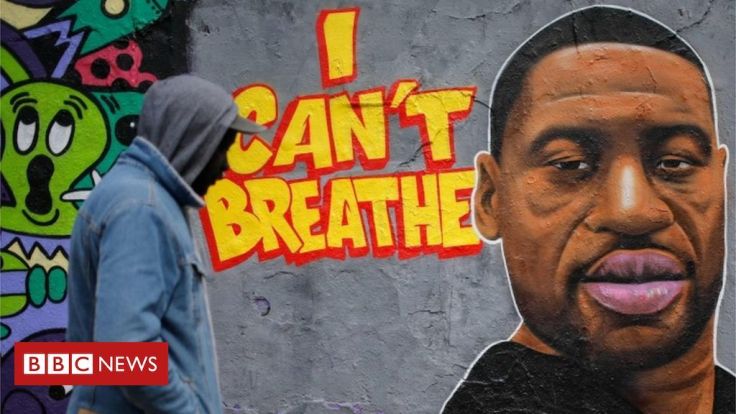
“I Can’t Breathe”: The Senseless Killing of George Floyd

I’m following the story about George Floyd. It’s unbelievable that he was choked on a sidewalk for eight minutes by police. The cops first said Floyd was resisting arrest, but I saw the video compiled by the New York Times. It does show that Floyd flopped on the ground, but it also shows that the officers were able to put him in the police vehicle. Then, he was dragged out of the vehicle and held down by two officers while another knelt on Floyd’s neck. The whole thing makes no sense.

Here are some questions I still don’t see answers for:
1. Why did Derek Chauvin kneel on Floyd’s neck even after handcuffing him? As onlookers pointed out in the video, Floyd was already on the ground in handcuffs. Why the need to inflict suffering on him? Plus, how could Chauvin have thought he could get away with this? There were onlookers and even people filming. The audacity of his actions angers and baffles me.

2. What were the other complaints already on Chauvin’s record? Has he been accused of using excessive force before? Also, he looked so comfortable with choking Floyd that it makes me worry that this isn’t the first time he’s knelt on a person’s neck. I’m waiting for others to come forward and report that he choked them, too. There’s already a report from NBC news that says since 2015 Minneapolis police have used neck restraints at least 237 times, and that during this period they choked forty-four people unconscious.

Thanks to a lovely email from a magazine called Creative Nonfiction, I received links to some very helpful resources that are highly educational in the areas of racism and racial profiling and the Black Lives Matter Movement. If you’re interested in learning more or helping, here are some links:

LEARN
A timeline of events that led us here (via The Root)
The 1619 Project (via New York Times Magazine)
Read up on specific issues (via blacklivesmatter.carrd.co)
Anti-racist books for kids and their caretakers (via White Whale Bookstore)
A nonfiction anti-racist reading list (via Publishers Weekly)
Ibram X. Kendi’s anti-racist reading list (via New York Times)
Black Pittsburgh writers (via Pittsburgh City Paper)
Articles, books, podcasts, teacher resources & more (Google Doc)

ACT
Protesting? Know your rights (via ACLU)
75 Things White People Can Do for Racial Justice (via Medium)
Commit to Justice in June (Google Doc)
20 actions white people and non-black POCs can take to show up for black people right now (via Medium)
Contact your representatives (via My Reps)
Vote

SUPPORT
Black-owned bookstores (via Publishers Weekly)
Another list of black-owned bookstores (via Lit Hub)
Black Lives Matter (Donations)
Movement for Black Lives (Donations)
Bail Funds (Donations)
Even more suggestions (via The Cut)

FOLLOW
Black Lives Matter | @Blklivesmatter
ACLU | @ACLU
NAACP | @NAACP
Legal Defense Fund | @NAACP_LDF
Color of Change | @ColorOfChange
Equal Justice Initiative | @eji_org

George-Floyd-the-man-whose-death-convulsed-US
Photo taken from BBC News


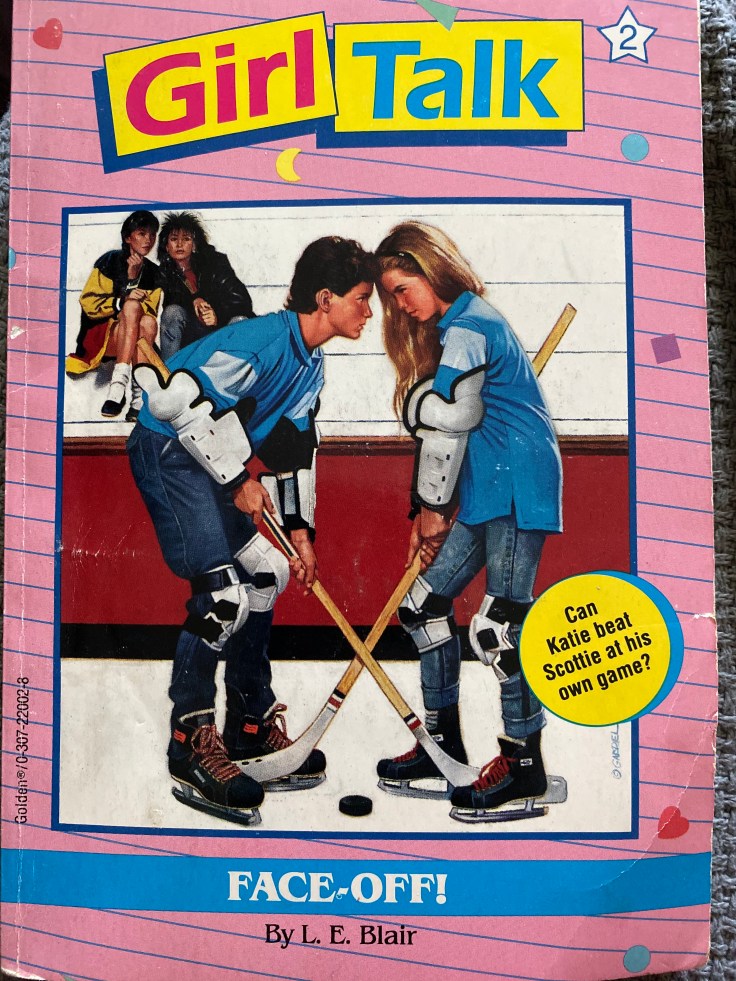
Girl Talk Series #2: Face Off!

Face Off--pic

When I started reading the Girl Talk book series in middle school, Face Off! was one of my favorites. I thought the message was cool: girls are just as good as boys. I still think the message is cool, but the overall storyline is annoying at times.

Katie Campbell, the blonde, blue-eyed preppy of the friend group narrates this one. It begins with her at the local ice skating rink whirling around and enjoying herself. She’s a great skater, good enough to try some moves she’s seen on figure skating competitions on television. As a kid, I knew nothing about hockey or ice skating, and I remember that it intrigued me to read about this girl in a state I’d never visited who was doing things I had never done. Anyway, Scottie Silver, 8th grade heartthrob, skates past Katie and snatches her hat off her head. She speeds off after him and chases him around the rink. Just as she grabs him by his belt loop, they knock a couple of other skaters over. No one is injured. Scottie grins at Katie and skates off. I reckon this is his way of telling her he likes her.

At dinner that night, Katie’s sister Emily mentions the incident with Scottie. Katie’s mother warns Katie to be ladylike and not play rough with boys. Katie’s mom keeps the house neat as a pin and expects her daughters to maintain a certain decorum. Katie feels pressure to conform.

Later, we see that Katie’s on the flag squad at her school, which means she’s a kind of cheerleader responsible for cheering at games and pep rallies while waving a flag around. Stacy Hansen (a.k.a. Stacy the Great) teases Katie one day after practice about wearing an undershirt instead of a bra. Flat-chested and sensitive, Katie is terrified of being teased by anyone about anything, so she runs into the flag coach’s office, hands in her flag girl uniform, and quits the team. Part of the decision to quit is that she doesn’t like being around Stacy so much, but another big motivator is that she doesn’t love being a flag girl and was only doing it because her mother wanted her to and because her best friend from last year (who has now moved away) tried out for the squad with her.

Anyway, Katie’s mother and her sister Emily are surprised and disappointed that Katie has quit the team, and Katie feels guilty. During lunch at school, Sabs mentions the upcoming hockey tryouts, and Scottie Silver starts acting obnoxious and basically saying he’s the best skater in the county and calling himself a one-man team. Randy Zak, who can’t stand Scottie’s egotistical bragging, stands up to him and proclaims Katie a better skater than Scottie and that Katie will try out for the boys’ hockey team. Katie, who embarrasses just as easily as Sabs did in the previous book, gets angry at Randy. Later, Randy says she thinks Katie should seriously consider trying out. Randy encourages Katie to show everyone that girls are just as good as boys. Katie’s courage grows, and she agrees to try out.

At Monday’s tryout, Coach Budd tells Katie in front of all the boys and spectators that there will never be a girl on his hockey team. Quiet Allison Cloud stands up and tells Coach Budd that Title IX exists partly to ensure that girls and boys be treated the same at public schools that receive federal funding, or something along those lines. Coach Budd relents and lets Katie try out. She is immediately “othered.” She skates toward the locker room to put on her uniform and pads, but then she’s stopped by Scottie, who reminds her that she cannot share the boys’ locker room. Flip, the one guy on the team who’s nice to Katie during tryout week, points out the visitors’ locker room and tells her she can change in there. Katie is wearing a bra that day, which she never wears and is only wearing now because of how Stacy teased her about the undershirt. Katie has cast aside her undershirts and now thinks that wearing a bra is the more grown-up thing to do, which is silly since she has no tits. Funny story, I had B/C cups when I was in sixth grade, and I decided not to wear a bra to school one day because they were scratchy and I hated them. One of my classmates called me out because my tits were bouncing uncontrollably. I don’t feel sorry for Katie for taking longer to develop. I looked like a grown woman at twelve, and it was not fun. Anyway, Katie takes off her bra and puts on her hockey uniform in the changing room. However, the bra gets hooked to the back of her pants and she doesn’t realize it until she skates out onto the ice and everyone laughs at her. She’s humiliated, and her friends have to go into the locker room and give her a pep talk until she can stop crying and muster the courage to go back to the tryout.

She makes it through the first day of tryouts and then goes to Fitzie’s, the afterschool hangout. It’s a restaurant with a 1950s theme. They serve hamburgers and ice cream floats and banana splits, etc. Anyway, at Fitzie’s Scottie warns her that the guys will start to play rough with her on the ice soon, only it sounds more like a threat than a warning. I’m starting to like Scottie less and less. First, he brags about how great he is at lunch, and then he threatens a girl with violence. Granted, Katie is trying out for a dangerous, physical contact sport, but the way Scottie takes pleasure in the idea of her possibly getting hurt is too much. Katie and the other girls only seem to like him because he’s cute, which shows how shallow they all are.

At home, Katie’s mom tells her that she heard from someone at the grocery store that Katie has tried out for the hockey team. They get into a fight because Mom wants Katie to give up hockey and Katie is determined to go through with the tryout. Katie winds up screaming at her mother, which she claims she’s never done.

On day three of tryouts, the guys gang up on Katie. Every time she gets the puck, they knock her down or hip check (whatever that means). Even the guys on her team during the scrimmage don’t try to help or work with her. She bravely takes a beating. Afterward, she’s already sore and knows she’ll be bruised the next day. She can barely move her arms well enough to change out of her uniform and is trying to muster the strength to walk home when Scottie picks a fight with her outside the rink. He says she better stop being a wimp if she wants to play a man’s game. Katie, rightfully fed up with his crap by that point, tells him that he is so intimidated by a fast skating girl that he and his friends had to beat her up to feel better about themselves. I was so proud of Katie for telling him off. Then, Scottie leans over and kisses her cheek. Ugh! It’s like those old movies where a man and woman argue passionately and then do something sexual like kiss passionately or jump in bed. Katie and Scottie don’t jump in bed, though, thank God. Instead, after Scottie pecks her cheek he runs away. Katie’s dumbfounded and also excited that he’s kissed her. I get that baby girl’s hormones are raging, but I still think Scottie is a jerk and not nearly good enough for Katie. Anyway, Katie tells Sabs about it that night on the phone and Sabs is in disbelief but also delighted that Scottie, the “make out King” has kissed Katie.

On Friday, Katie finds out that she made the team. Teachers and even kids she doesn’t know well congratulate her. Scottie calls her that night to remind her to be at the rink on time for their Saturday game. It’s a short and awkward conversation, and he hangs up without saying goodbye. Katie calls and tells Sabs about Scottie’s call. Then Sabs calls Allison, who interprets Scottie’s behavior. She says Scottie likes Katie and that he was probably embarrassed to call her and so he made up some excuse about letting her know when to arrive for the game. Allison was always the intuitive one in these books. Earlier in this book she’s the one to notice Scottie watching Katie, even before Scottie snatches Katie’s hat and skates away with it. I like that Allison is intuitive, but I think someone should warn Katie to stay away from a guy like Scottie. First his arrogance is on display, and then he physically abuses Katie. Kissing her after trying his best to bruise her body is problematic to me. I would’ve liked Scottie a lot better if he’d been supportive of her or stood up for her during the tryout.

During the first game, Katie rides the bench until the starting left wing, Brian, is injured. Katie has to substitute for him. She steals the puck from the other team and passes it to Scottie, who scores the winning goal right before the buzzer. Everyone chants her name. Afterward, the coach tells her that he knew she was a winner when he chose her for the team. Scottie apologizes for being obnoxious to her on the phone, though he offers no apologies for ganging up on her during tryouts. She instantly tells him she forgives him. Ugh! Then he asks her to go to Fitzie’s for a soda. Stacy, who is supposed to be his girlfriend, storms off with her friends. Scottie offers to carry Katie’s bag to the restaurant, but she tells him she can handle it. The book ends with them laughing over her decision to carry her own bag.

Overall, I do like the themes of this book. There are two that I picked out. One is to never let bullies determine who you are or what you should do. The other theme is that hard work and perseverance pay off. These are good lessons for a middle schooler to learn. Still, I wish Scottie wasn’t such a jerk, and the way Katie easily forgives his behavior bugs me. Plus, Scottie has no redeeming qualities aside from being sooo cute. I guess his apology was a good gesture, but the fact that he bullied her to begin with irks the heck out of me.

Other observations:

  1. Stacy is “going out” with Scottie in this book, which I guess means that they hang out after school. Stacy was also “going out” with Alec, the boy Sabs crushed on in the previous book. Not trying to slut shame her, but how many boyfriends could a girl have during middle school? We’re also told that Stacy dated Nick Robbins back in sixth grade, so we know she’s had a least three boyfriends by age 12. She was also wearing diamond earrings at the ice skating rink in the first chapter of this book. This chick acts twenty-five instead of twelve.
  2.  Allison looks beautiful as always on the cover of this book, though she looks about eighteen instead of thirteen. Randy looks like her mullet-haired mom.
  3. In one scene Randy wears a flapper-style dress and cats-eye glasses. Where does she get such an outfit? I go thrifting sometimes, but I never find flapper-style dresses at Goodwill, and these books were written in the early 90s, so I know Randy didn’t order a 1920s-style dress off the internet. Unsolved mystery.
 

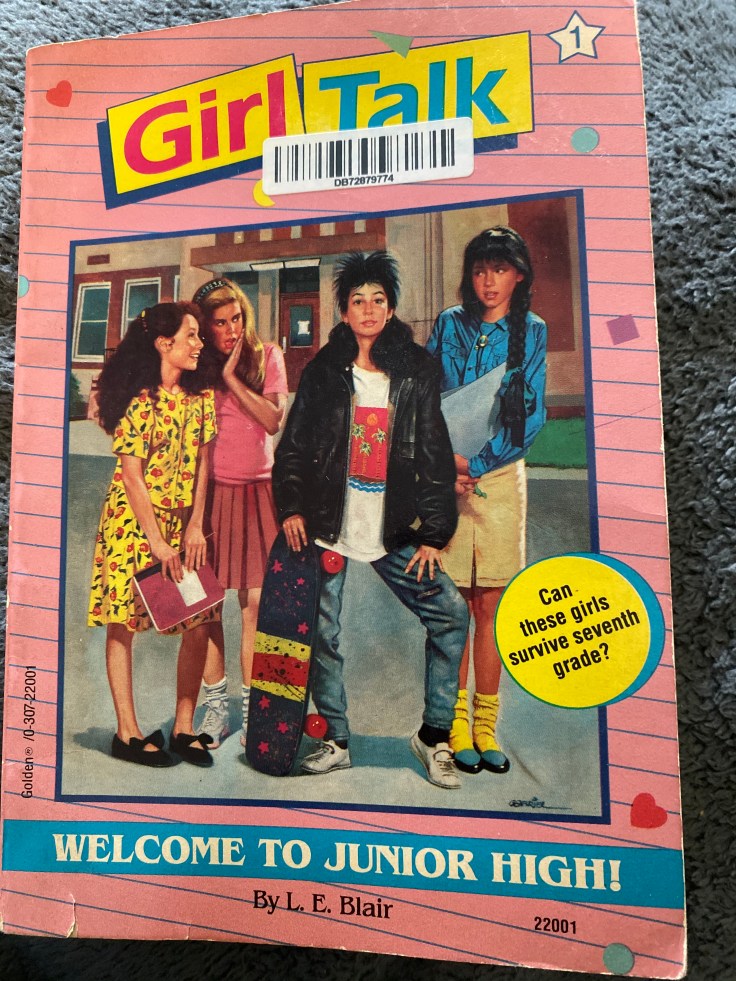
Girl Talk #1: Welcome to Junior High

When I was in middle school, I read several popular book series catered to young girls: Sweet Valley High (and Twins and University, too), Baby-Sitter’s Club, and even one or two Canby Hall books. Though I read more Sweet Valley than anything else, looking back I see that series was the worst of the lot. The selfish, shallow characters promoted unhealthy and amoral ideals for young girls. Despite having read hundreds of those books, I remember the plots of only a dozen or so, which fails the book test. For me, the one question book test is this: Do you remember the plot of ______ years after having read it? If you don’t, perhaps the book didn’t have a profound impact on you.

The Sweet Valley books were re-capped on a website called The Dairi Burger, which I followed a decade ago. Robin Hardwick does an amazing job recapping those books, and she does it with side-splitting humor, too. She even calls the books out on their crap. The authors had a habit of fat-shaming and the characters bullied people who were different. Even the practical, “smart” and “kind” twin often cheated on her boyfriend. Every book dedicated space to fawning over how good-looking the twins were. The twins’ mother was often mistaken for their older sister, and other women were so jealous of her looks that someone once tried to kidnap her and steal her face for a face transplant. No joke. Those books were beyond ridiculous.

The Girl Talk books had a profound impact on me. I remember the four best friends on which the books focused: Katie Campbell, Allison Cloud, Sabrina Wells, and Randy Zak. Just browsing over the books’ covers online, I remember the plots of most of the ones I read. These books weren’t as readily available as the Sweet Valley series or the Babysitter’s Club. I believe I bought my Girl Talk books via a school book fair’s catalogue. I never saw them for sale at the Barnes and Noble or at Books a Million like the other popular girls series. I was heartbroken when the books stopped after #45. And I couldn’t find them in local bookstores. Now, with the use of Amazon and Abebooks, I can go back and read them again. I still have a few that I bought when I was a kid, and I can order the others.

Girl Talk #1

Here goes. Katie, Allison, Sabrina, and Randy live in the small town of Acorn Falls, Minnesota. They’re 12-13 years old, and in the first book, which I’m re-capping here, they have just begun 7th grade. Each book is narrated by one of the four main characters. Sabrina Wells narrates this first book called Welcome to Junior High. We find out that Sabrina has four older brothers, including a twin brother named Sam. She’s bubbly and loves fashion magazines and horoscopes. She’s also boy-crazy. In the span of this first book (all of the books are around 120 pages and printed in big script, so that you could read one in about two hours), Sabrina has crushes on three different boys: her brother’s friend Nick, a ninth grade boy named Spike who plays in a local band, and an 8th grade boy named Alec whose lap she lands on while trying to slip out of the 8th grade math class she accidentally walked into while running late on the first day of school. Alec is the one she crushes on first, and she loves that he’s an “older man.” He looks just like Tom Cruise, her favorite actor. Later, when she meets Spike, she thinks he reminds her of Johnny Depp, her other favorite actor. It’s amazing how these books are so dated (this first one came out in 1990), yet some of the cultural references remain the same. I guess some girls still like Cruise and Depp, though they’re kinda aged heartthrobs now. I guess if these books were updated, the young girls would like…yikes, you can tell I’m almost 40. No idea who the girls would swoon over. Lol. Until I re-read this one, I didn’t realize Johnny Depp was so famous already in 1990. But I guess Nightmare on Elm Street and Platoon had already been released, and Scissorhands came out that same year.

Anyway, here’s the plot. The homecoming dance is coming up, and the whole story leads up to that big event. Sabrina wants to go with Alec the 8th grader, but he’s already been spotted hanging around with the principal’s daughter, Stacy Hansen, a snooty 7th grade girl who wears heels already and always dresses nice. Sabrina also thinks Nick Robbins, her brother’s friend, is cute, but he’s in the 7th grade with her, and she’s decided she only likes “older” men. Nick asks Sabrina to the dance while they are lining up to march in the town parade. Nick accidentally knocks her over with his drum, and she tries to talk to him but clumsily spits out her clarinet reed. Cute scene. Anyway, Sabrina agrees to go to the dance with Nick, but later when she is decorating the gym with Randy, Katie, and Allison, this 9th grader named Spike (who has black eyes like Johnny Depp) comes in and asks her to dance. Nick walks in and sees her with Spike and is obviously jealous, only Sabrina is too dense to realize it. Later, Nick calls and says he won’t go to the dance with her because he has already asked someone else. Sabrina is crushed, but her friends talk her into going to the dance anyway. At first she pouts because she sees Nick talking to some other girl she doesn’t like and because Alec is dancing with Stacy. Then, Spike, whose band is playing at the dance, literally puts a spotlight on her and dedicates a song to her. Nick comes forward and asks her to dance. Though she shouldn’t even be talking to him since he dumped her, they talk as they dance. He explains that he was angry when he saw her with Spike, and he admits he never asked anyone else to the dance. They agree to be friends. The book and the night end with Sabrina hanging out with Randy, Katie, and Allison.

There are some side plots. One is that Katie goes to the dance with Sabrina’s twin brother, Sam, and for reasons unknown this bothers Sabrina. Randy is new to town from New York City. Her haircut is spiked on top, and when Sabrina first meets her Randy wears a leather bomber jacket, ripped jeans, and a T-shirt with palm trees on it. (Sooo cool, according to Sabrina.) Allison is the quiet one who is Native American. I remember being enthralled by her when I was a child. Most of the books I read had majority white characters. I’d never read a story with Native Americans until I read Allison’s character. Her personality is bookish and quiet, very similar to mine. I used to share these books with my girl cousin when I was in middle school, and Allison was her favorite character. I liked Allison and Katie the best when I was a kid. I wonder if my opinion will change as I go through them again.

Grade: B. Sabrina is a little too boy crazy for my taste. She’s still quite nice, though. I also like that Randy kept standing up for Sabrina whenever Stacy tried to bully and belittle her. In one scene, Stacy and her friends steal Sabrina’s self-improvement notebook, which is basically a diary in which Sabrina writes about her goals to better herself, and Stacy and her friends read the thing aloud in front of a group of kids in the hallway. Sabrina is embarrassed, because anything embarrasses a tween-age girl. Randy steps in, snatches the book away and gives it back to Sabrina. She also steps in during another scene, knocks into Stacy and spills Stacy’s entire lunch all over her. Ah. Seventh grade scandals.

Next time, I’ll recap #2, and we’ll learn more about Katie Campbell, who narrates that one.

The Long-Awaited Conclusion to the Logan Family Series

I’ve loved Mildred D. Taylor’s books since I was a child. In eighth grade, I listened as my Georgia history teacher, Mr. Benton, read aloud from Roll of Thunder, Hear My Cry each week. I fell in love with Cassie Logan, the book’s intuitive, beautiful protagonist. The other books I read as a child featured mostly white female protagonists. Sure, there was Allison Cloud, the bookish Native American girl from Girl Talk, and there were Claudia Kishi and Jessi Ramsey from The Babysitter’s Club, but other than those few the characters in the books I read were mostly white.

The white authors I read frequently reflected on how blue a character’s eyes were, and I could always tell what the authors’ beauty standards were. The authors of the Sweet Valley series loved long blonde hair and tan skin (but not black skin) and a size six body. In the stories I write, the characters don’t have blue eyes, and I don’t favor the ultra-thin beauty standard either. I often struggle to describe my beautiful black female characters without using food comparisons. Yes, that’s a thing. I’ve read books by writers, both black and white, who say a black woman is peanut butter brown, has skin that shines like pudding, or is the color of a pecan. Food. Food. Food.

Reading a book series in which the black female telling the story doesn’t suffer low self-esteem is something that gave me hope as a child. Stop for a moment and consider the most popular dark-skinned black women in literature. There’s Celie in The Color Purple, the narrator of Salvage the Bones, and of course Pecola Breedlove in The Bluest Eye. Though there’s hope at the end of The Color Purple, overall Celie and the other protagonists from the aforementioned books are stepped on, shat on, and all but tarred and feathered by their tormentors.

Then we have Cassie Logan, a young woman who is smart and hard-working and has a life that, even in Mississippi in the 1930s-1940s, isn’t completely hopeless. I’m proud of Cassie Logan, proud as if she were my own daughter. I love how her family sticks up for one another and stays together. I can write beautiful black females because another author came before me and wrote Cassie Logan and did it like a boss. Mildred Taylor didn’t write black women with white readers in mind. She didn’t say that Cassie was pretty “for a colored girl” or that she had white features, like thin lips or a thin nose to make her somehow more palatable or attractive to white people.

Today, I went to Barnes & Noble and bought the last book in the Logan family series: All the Days Past, All the Days to Come. (This says a lot because I never buy those expensive ass brand-new hardcovers–the last one I bought was Harper Lee’s second novel–and I prefer to buy used books cheaply.) For the next week, I will catch up with Cassie Logan, who last narrated the series in a book released in 1990. Yes, it’s been thirty years since The Road to Memphis was first published, and the other books Taylor has written since then were both prequels and not narrated by Cassie. This new book was not only a long time coming, but one I did not expect until last summer when I saw it available for a pre-release purchase on Audible. For years, I’d thought Taylor had passed away. I kept wondering if she’d died before finishing the series. For years, I’ve wanted to know what became of Cassie’s family after WWII. Did her brothers serve in the armed forces? Did Cassie pursue her dream of becoming a lawyer? I wanted to know if Cassie would marry the lawyer she met in 1941 or if she’d marry Moe, the sweet man from her community. Now, sitting here typing this, with the newest and last installment of the beloved series, I wonder, will this book, like all my favorite books, break my heart?


The Thing that Bothered Me This Week: No One in This Town Can Do a Black Woman’s Hair

I’ve been trying to find a good hairdresser in middle Tennessee since last year. I went to one lady who did just an okay job, but the bigger problem is I have to book her two weeks in advance. For the past few months I’ve driven past a certain salon here in town, and my mother has urged me to go in and ask if they do black hair. I kept looking for signs that they did my type of hair. I never see people going in or out of the salon as I’m driving by, but granted, I don’t often pay attention every time I drive by. I have noticecd that the boy in the sign out in front of the salon looks Hispanic or possibly mixed race, and the other poster is of a white woman.

I finally called yesterday and asked if they did black hair. The woman on the phone said she didn’t but that one of her co-workers, who was absent that day, does black hair. I gave her my number and she said she’d call right back. After she didn’t call me back yesterday, I drove to the salon to make an appointment. The lady who does black hair wasn’t working today either. So they called and got her phone number from someone else. I tried calling her, but her phone goes straight to voicemail. I left her a message, but for some reason I doubt she’ll get back to me.

I called the JC Penney hair salon today, even though I’ve never seen any negroes in their salon at any time ever. The lady on the phone said she’s the one at the JC Penney salon who can do black hair. I felt relieved. Two seconds later she asked, “What kind of hair do you have?”

“Just regular black people hair,” I said, and then burst into 1/3 amused, 1/3 annoyed, and 1/3 baffled laughter.

She did not laugh.

“I mean, is it very coarse?” she asked.

“Yeah,” I said, hesitating a little. I’d heard black women hairdressers in the past refer to it as soft, and I’m not sure if it would be coarse compared to other black people’s hair or if it would only be coarse to white people. “Yes,” I said, sounding a bit more confident. “It’s coarse and curly. Kinky too.”

She made the appointment for me, and after we hung up the phone she called back five minutes later as I was driving to work. She left me a voicemail saying she doesn’t have “the right products” to “stretch out” my hair.

WTF? I never asked for a relaxer. I only want someone to wash my hair and set it in thin rollers and put me under a hair dryer. I’d do it myself, but I’m not good with rolling my hair to make it lay the way the professionals do it. The JC Penney lady gave me the number to another white lady who supposedly does black hair. I called this lady and she told me her hair dryer is broken and thus she cannot do my hair either. Am I going to have to drive all the way to Nashville to get my hair done? Looks like.

The Person Who Bothered Me This Week: Dennis Rodman

Dennis Rodman has been on my mind lately. I remember when I was in high school a black man was killed by some white supremacists in Texas. One of my cousins claimed Rodman sent money and condolences to the victim’s family. I don’t know if this kind act can truly be attributed to Rodman, but just hearing a rumor that he did that gave me some respect for Rodman.

Last week, I watched ESPN’s documentary Rodman: for Better or Worse. It’s part of their 30 for 30 series in which they profile various athletes and teams. Anyway, I DVR’d the program and was half-watching it while lying on the couch dozing off when I heard a white woman being interviewed. This woman is someone close to Rodman, the matriarch of a family Rodman lived with when he was an adolescent after his own mother kicked him out of her house. Anyway, the white woman being interviewed said Rodman didn’t like black women, which disappoints me. What have black women ever done to Dennis Rodman?

I did a half-assed search on the web a few days ago to see if Rodman had publicly slurred or dissed black women. I found an article online from years ago in which he told a magazine that black women wouldn’t date him when he was poor. But is that a good enough reason to dislike all of us, especially considering that many white women probably wouldn’t have dated a poor version of Rodman either. The white woman in the 30 for 30 documentary openly admitted to calling Rodman the n-word when she grew angry at him, and Rodman said himself that growing up in Oklahoma in a white community he was often slurred and mistreated by whites. So why would he turn around and say that it’s black women he doesn’t like?  In the other part of his magazine interview, he claimed dating white women as an NBA player is popular, which we know already, but why turn against black women? The other thing he said is that dating white women brings something different, which makes it sound like he is aroused by taboo or fetishism, which is well within his rights, but it still doesn’t explain why no love for black women is given.

Anyway, I don’t like him anymore.

Blog at WordPress.com.

Up ↑